What Defines the Character of a City?
Its culture.
By Robin Blackstone
New York. Is it the artists, the writers, the galleries and the newsrooms? The world's hub for finance? The kings and queens of empire passing through? The policy wonks? Or is it, in the end, the immigrants, who appear on none of those lists? In truth it is all of them, in one place, and what they make together: a culture of connection, of diversity, and of regard for a new idea wherever it arrives from and regardless of the price paid for admission.
Halloween is one piece of the evidence.
Halloween on Sixth Avenue
Every other night of the year, New Yorkers are experts at not looking at each other. Two hundred strangers in a subway car, all studying their shoes. It is not rudeness. It is how eight million people live on top of one another without coming apart. Ask a New Yorker how they can sit shoulder to shoulder with six people they don't know on a park bench and be completely alone, and you'd understand.
One night a year, the rule is suspended. On Halloween, the city comes out to be looked at.
Halloween 2026, the Village, with my camera: from morning coffee to the chaos of the evening, in a crowd the parade puts at two million, from every borough. These photographs are what I saw.
Where the day began
Nearly every morning a group of people as different from each other as can be found, gathers at the News Bar on University Place to share coffee and their lives. We go early, so we can sit and talk. Some of the group have passed. A few are still young. We are observed by others who come in and out, wondering how they get to stay. The circle grows by a person or two every so often. A microcosm of the city itself.
Halloween is one of the gang's big days. Most of us dress up. Two of us carry cameras. The plan is always the same: the photographers go to the side streets and then the parade, the rest to dinner to admire the costumes. It is a celebration of being yourself, in whatever form that takes for the day.
Jim is the master of costume. This year a cockatoo turned up with a sign on the odds of being killed by a cockatoo (low, never zero). He is joined by a devil, and a man in a gold mask. The first photographs of the day were against the News Bar's mural.
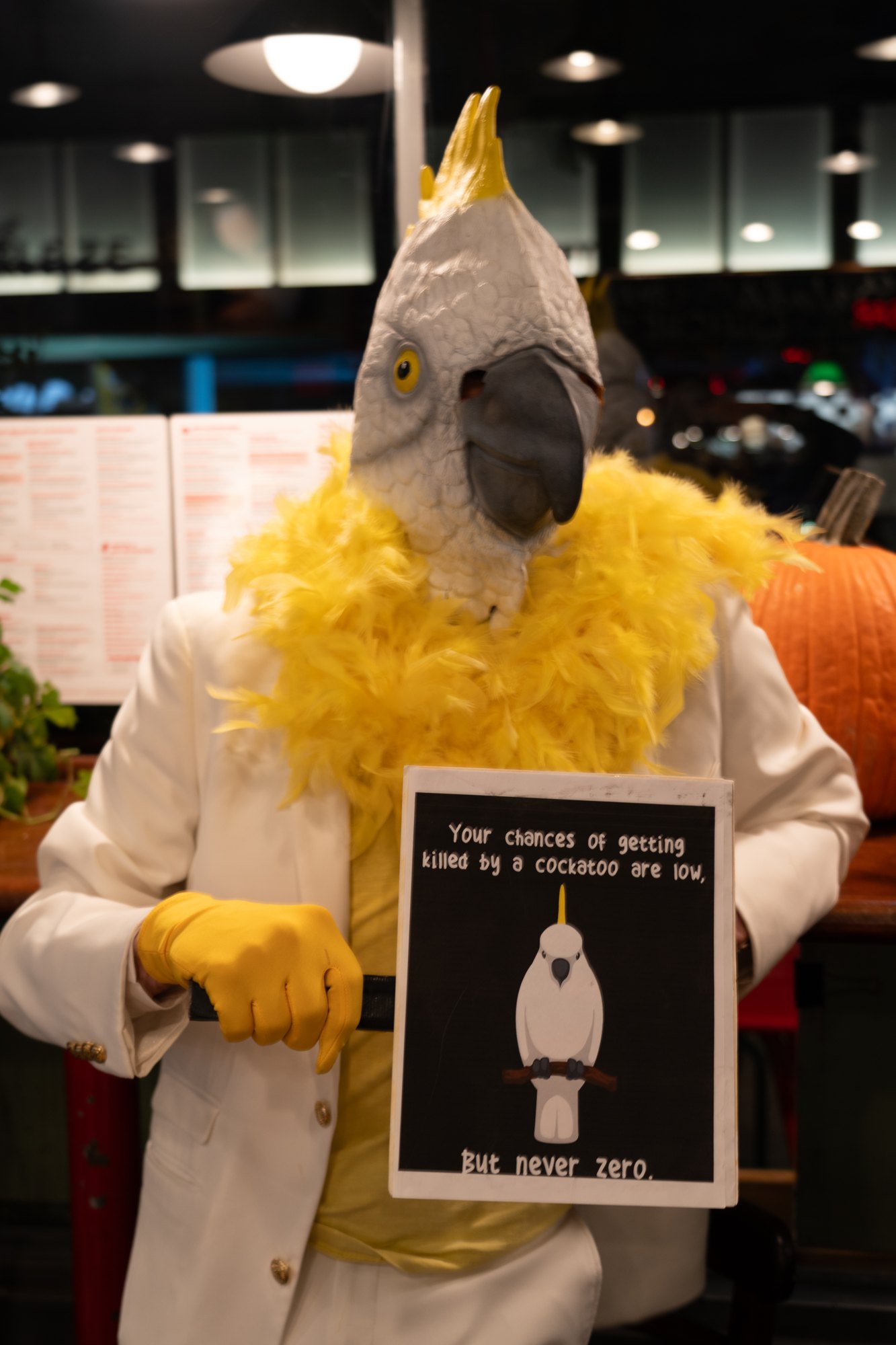
The cockatoo with the sign. News Bar, University Place, morning. Photograph: Robin Blackstone, MD
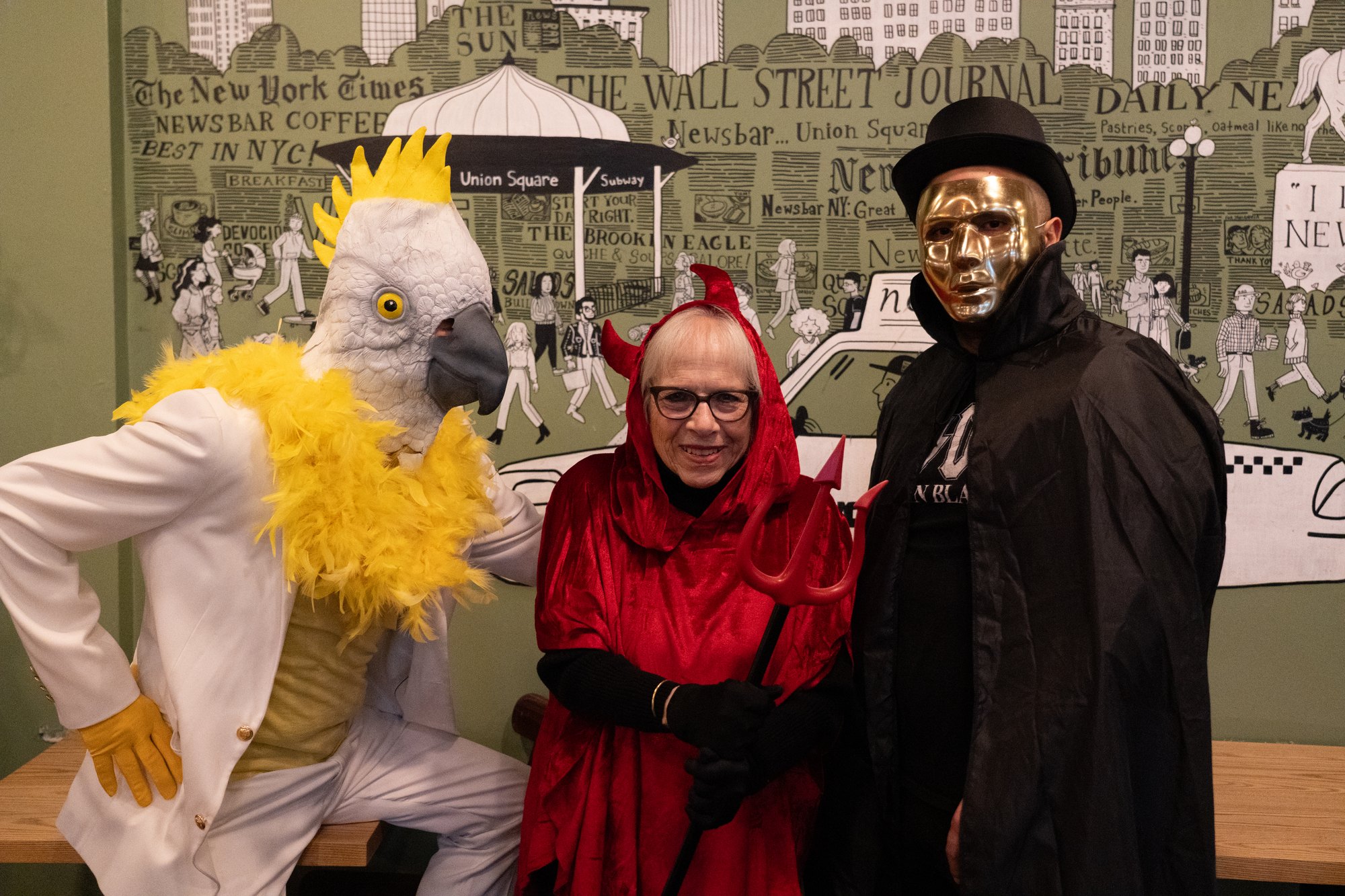
Cockatoo, devil, and the man in the gold mask. Morning at the News Bar. Photograph: Robin Blackstone, MD
A parade that belongs to no one
The Village Halloween Parade began in the 1970s as a walk for children. Ralph Lee, a puppet maker at Westbeth, led his kids and their friends through the neighborhood behind the giant puppets he had built. Within ten years the crowd passed a quarter of a million and the parade moved to Sixth Avenue. Jeanne Fleming has directed it since 1985. What feels in the moment like chaos is more scripted than it looks.
It has been cancelled once, in 2012, when Sandy took the Village's power. The next year the public paid to bring it back. In 2001, seven weeks after the towers fell, it marched behind a phoenix. This year was the fifty-third. The theme was Body and Soul.
The parade does not survive in spite of what happens to the city. It survives because of it. A culture that puts on a costume seven weeks after September 11, 2001, and raises the money to march again the year after a hurricane, knows how to recover. Resilience is not only a personal trait. A place teaches it, one day and one night at a time. We see it on the news from all over the world. It is what defines a culture.
Two things about this parade explain a lot. It is a night parade. It starts at seven, well after dark, and the dark is the point: the puppets are lit from inside, the costumes carry their own lights, the avenue becomes a stage.
The dark is not the only point. The people marching are a fraction of the millions who line Sixth Avenue, and the crowd is in costume too. Go out before dusk and you can photograph them, ten deep on either side. The essence of New York is here, in the fragile dance between the watchers and the doers.
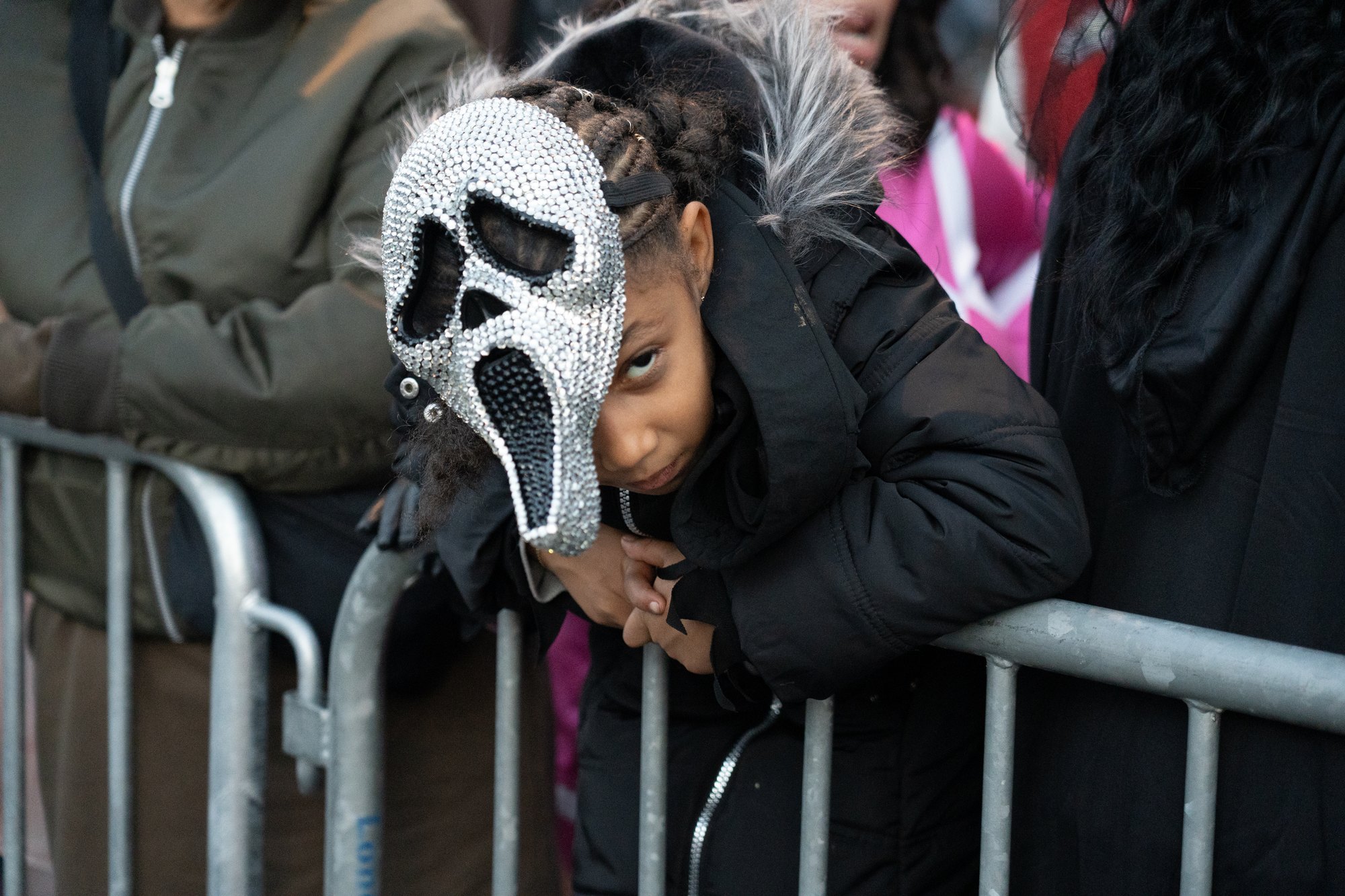
Waiting at the barricade. Photograph: Robin Blackstone, MD
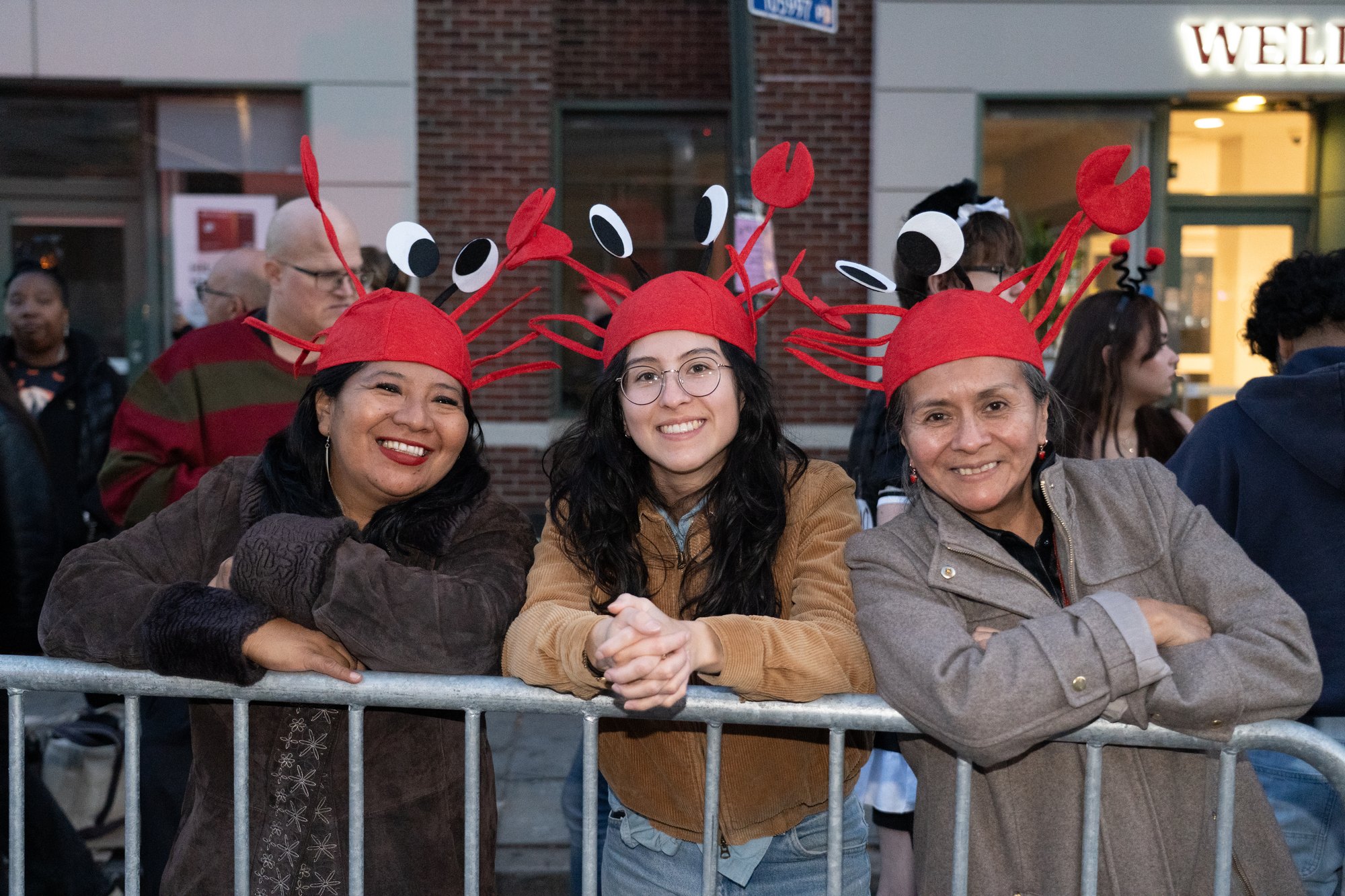
Lobster hats, Sixth Avenue. Photograph: Robin Blackstone, MD
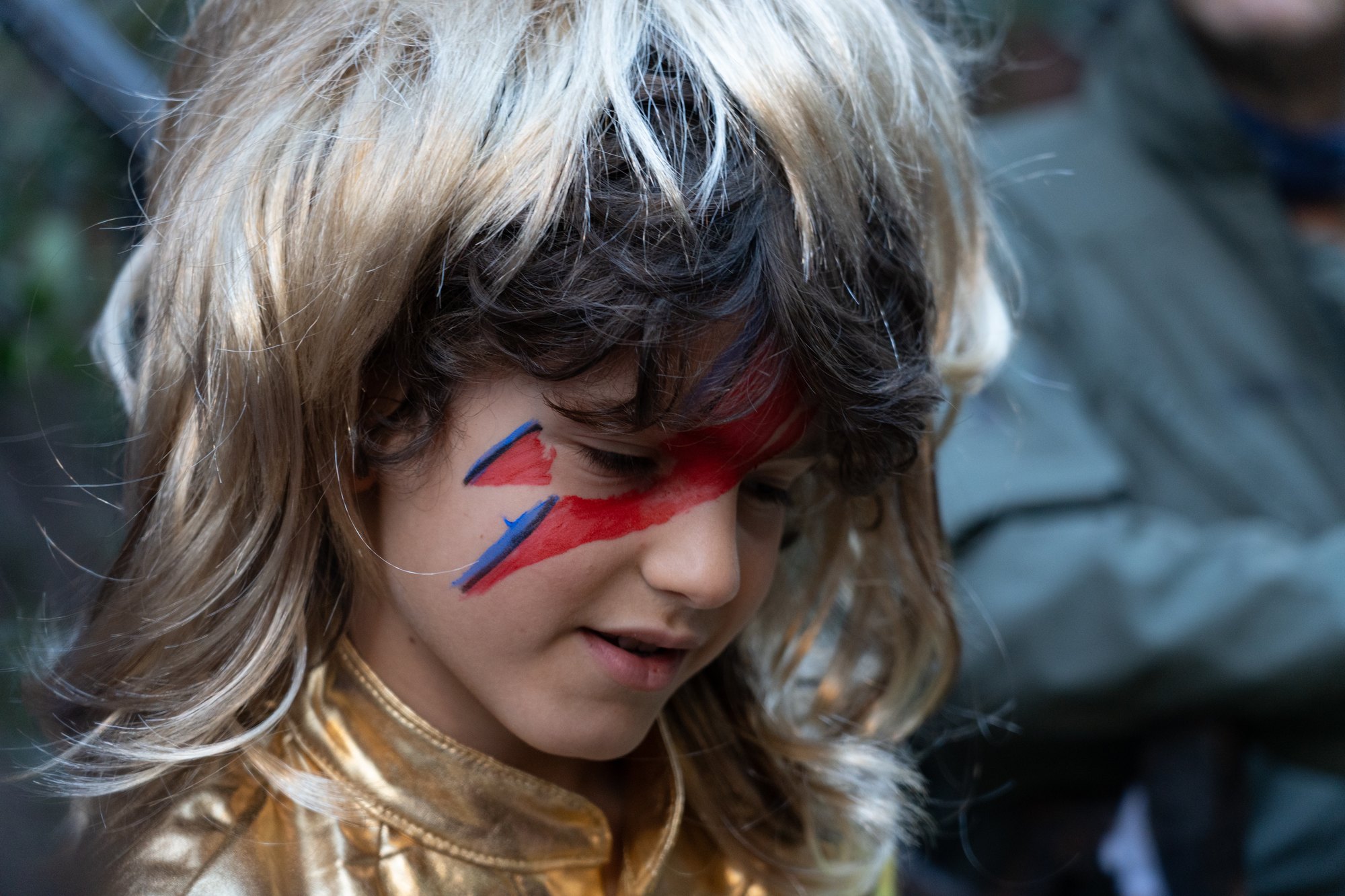
Lightning bolt. Photograph: Robin Blackstone, MD
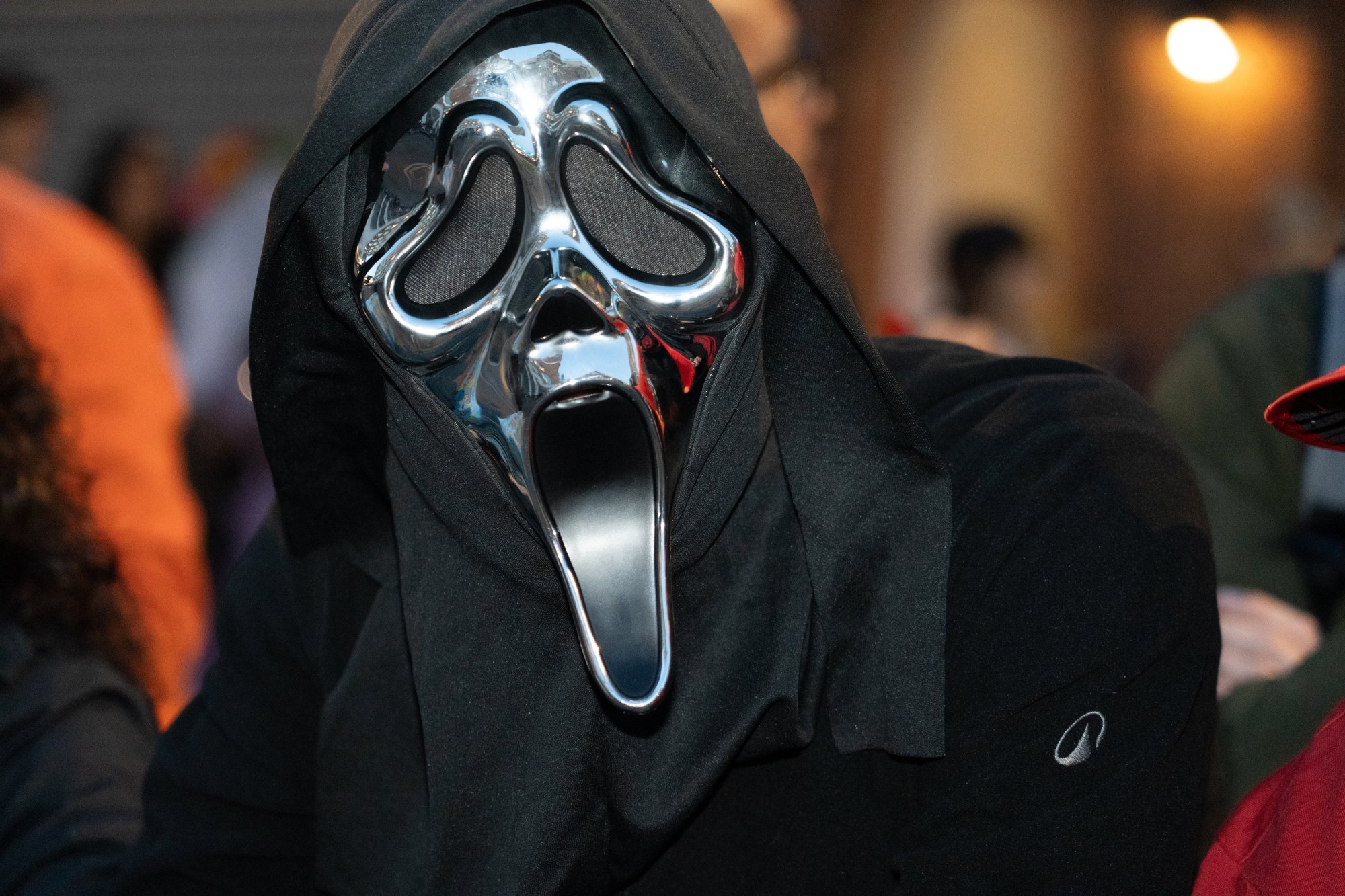
Chrome. Photograph: Robin Blackstone, MD
Who comes
Stand at a barricade on Sixth Avenue for an hour and you will hear every language the city speaks. A family in matching lobster hats on the rail. A boy in a rhinestone ghost mask who could not wait. Three teenagers in a Guy Fawkes mask and North Face jackets, there because tonight strangers greet each other, and they want in. A plague doctor who has done this before. A bride and groom in stage blood. A man who came as a Van Gogh self-portrait, frame included.
They come from every borough, from New Jersey and Long Island, to be among people they can learn from, laugh with, talk to as they will talk to no one else this year. Here it is 8.6 million people, a third of them born in another country, on twenty-three square miles of island and the four boroughs around it. Most nights the city keeps to itself. Tonight it turns and faces itself, in costume.
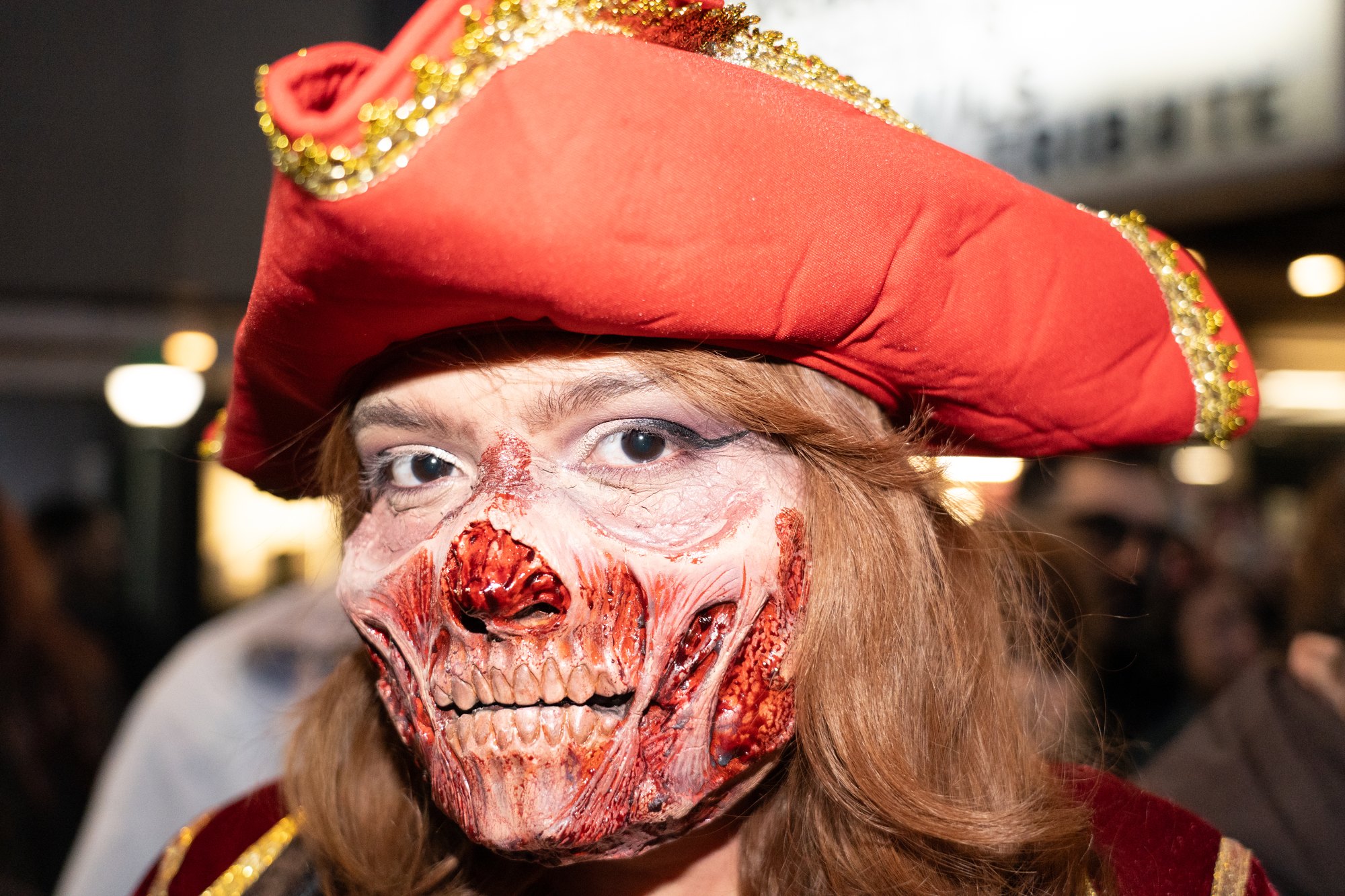
Pirate, well past her prime. Photograph: Robin Blackstone, MD
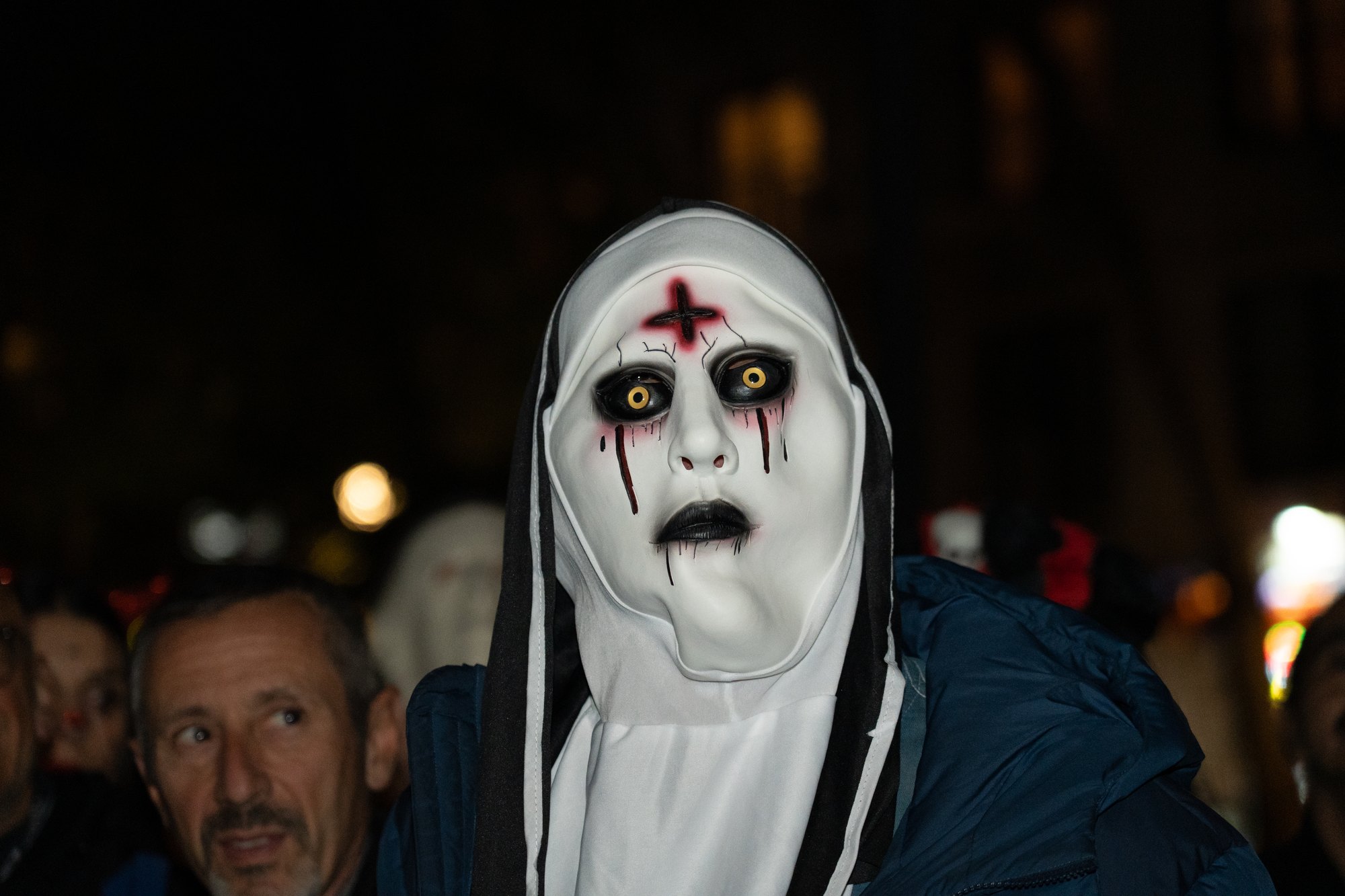
The Nun, and the man who just noticed her. Photograph: Robin Blackstone, MD
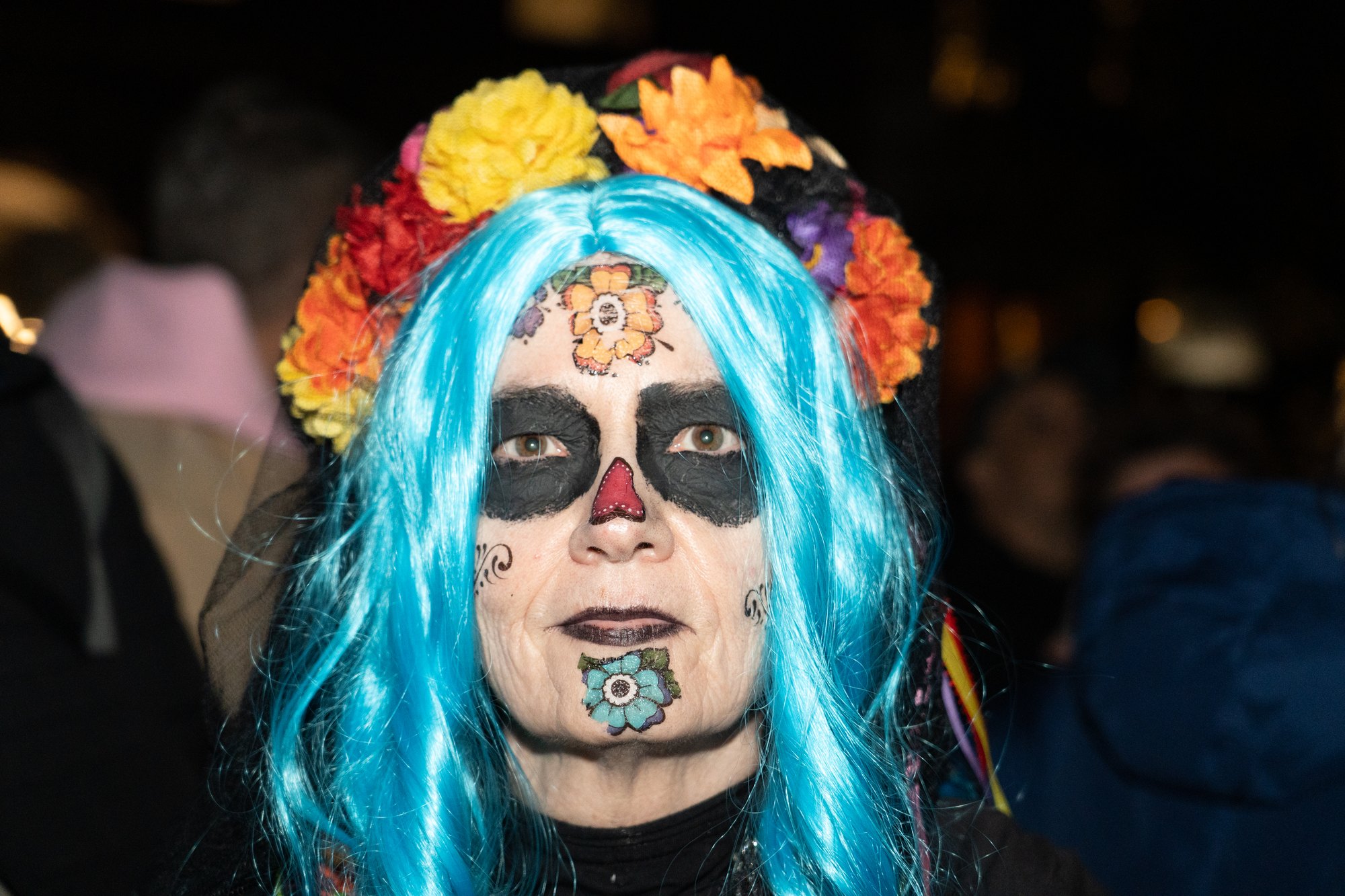
Catrina in a blue wig. Photograph: Robin Blackstone, MD
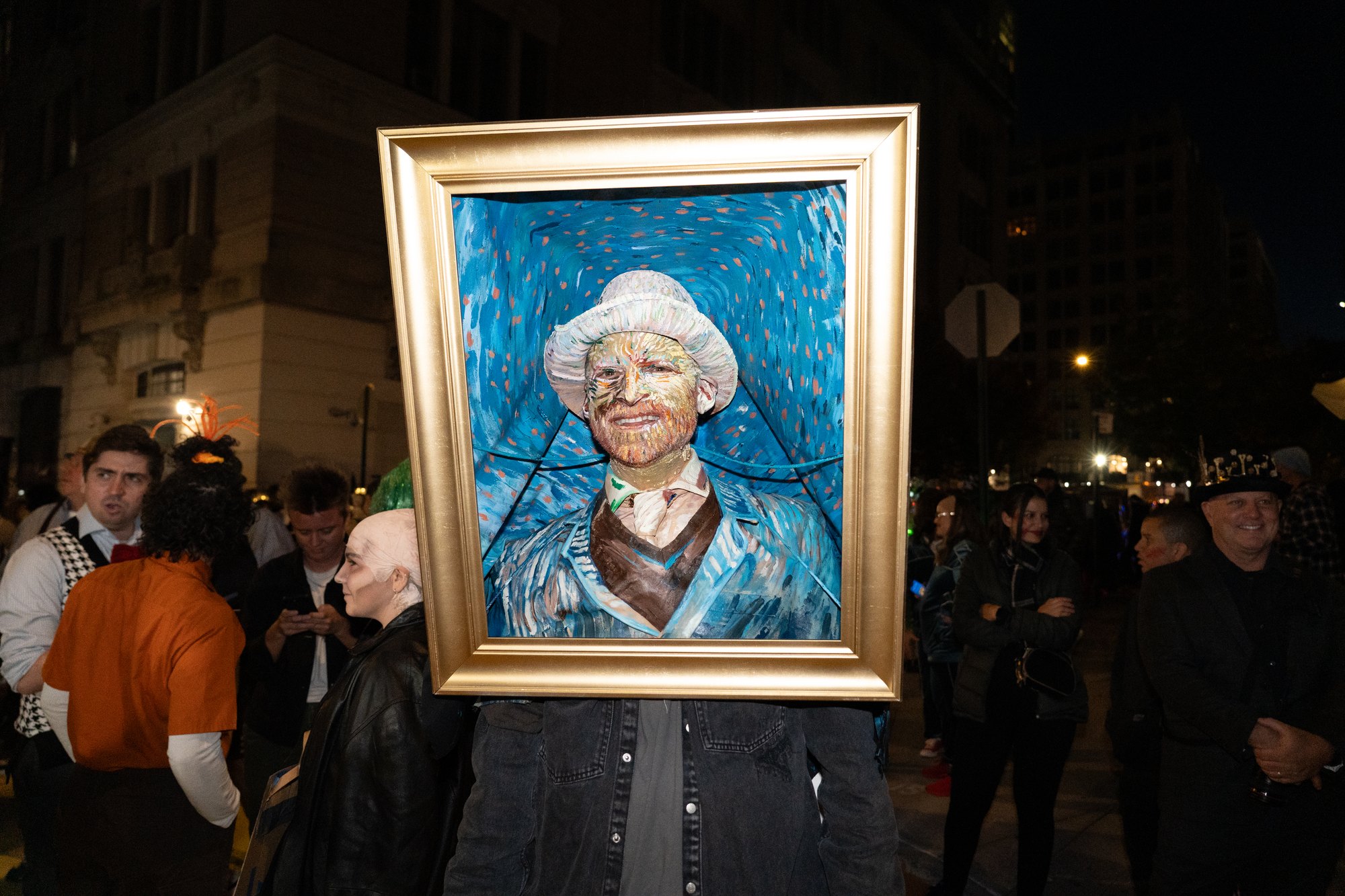
Self-portrait with frame. Photograph: Robin Blackstone, MD
The puppets
The giant puppets are the parade's signature. They are built upstate through September and October by Superior Concept Monsters and hundreds of volunteers who give their weekends to papier-mâché, then carried down the avenue by teams of puppeteers. The three in my photographs, two women and a man in paper and cloth, lit from within, stood two stories tall and moved as if they were listening to each other.
That is the part I keep coming back to. The costumes are individual. The puppets are collective. Nobody could make one alone, and nobody is paid to.
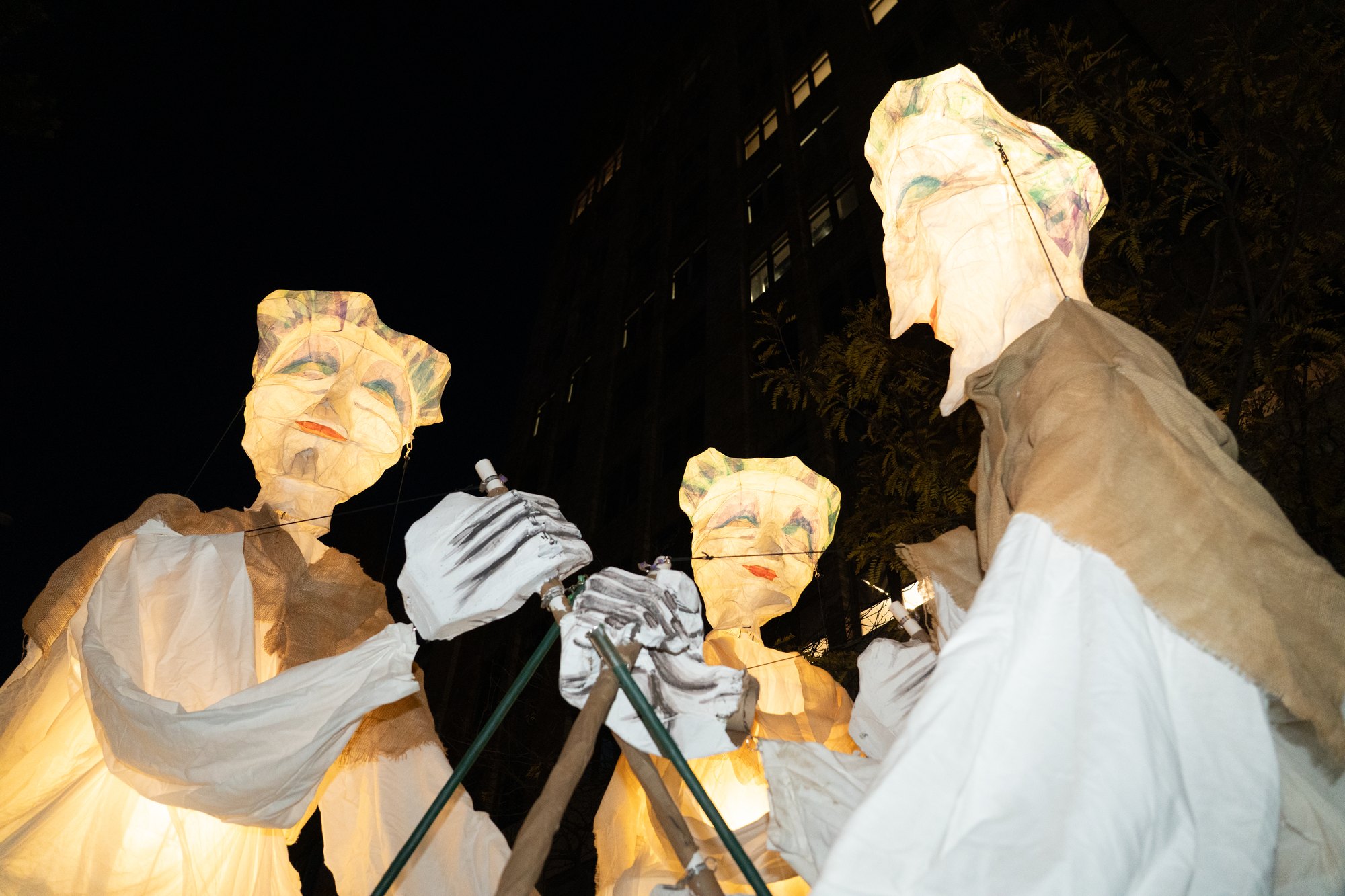
The puppets. Superior Concept Monsters, hundreds of volunteers, two stories tall. Photograph: Robin Blackstone, MD
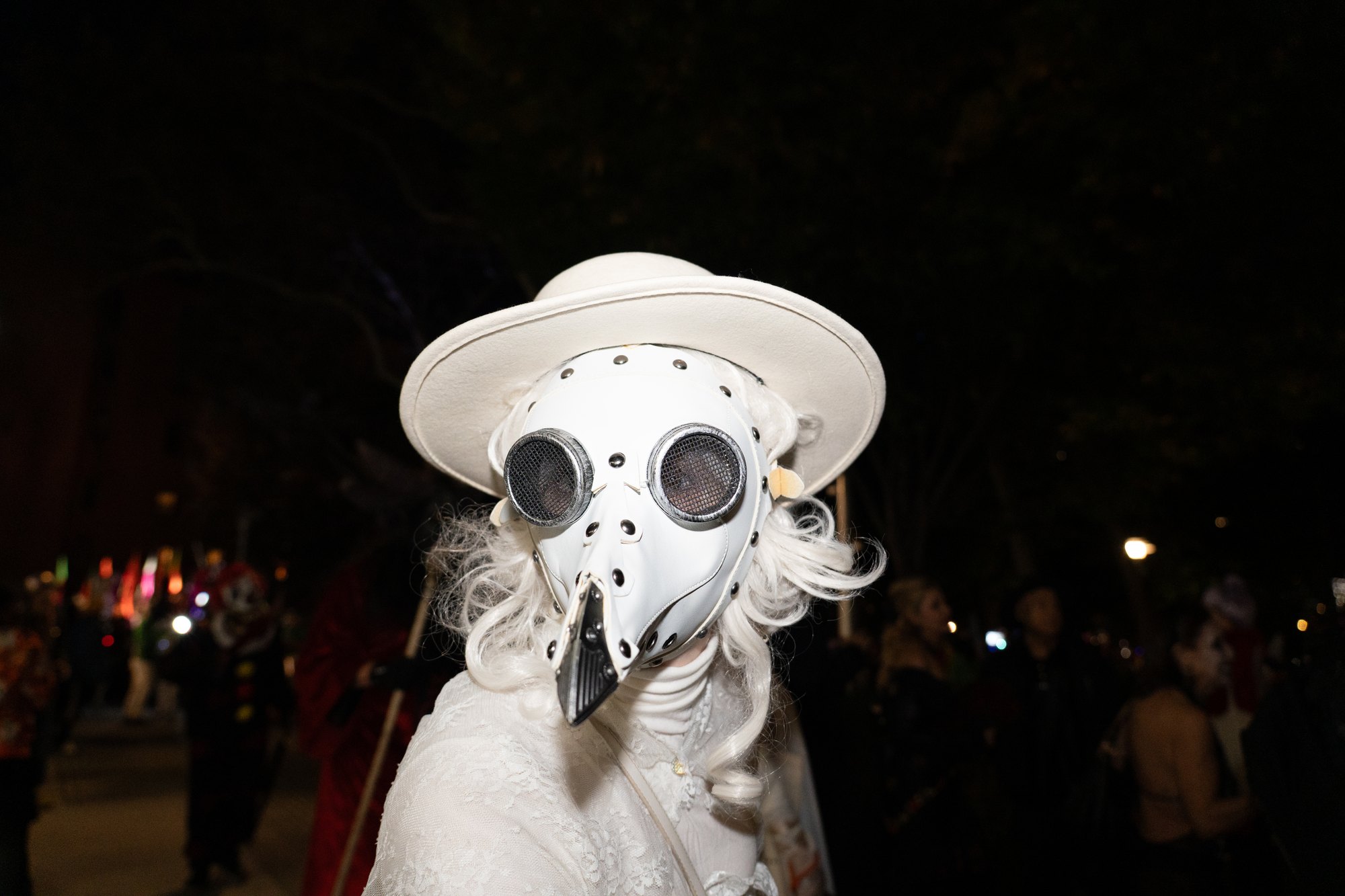
Plague doctor. Photograph: Robin Blackstone, MD
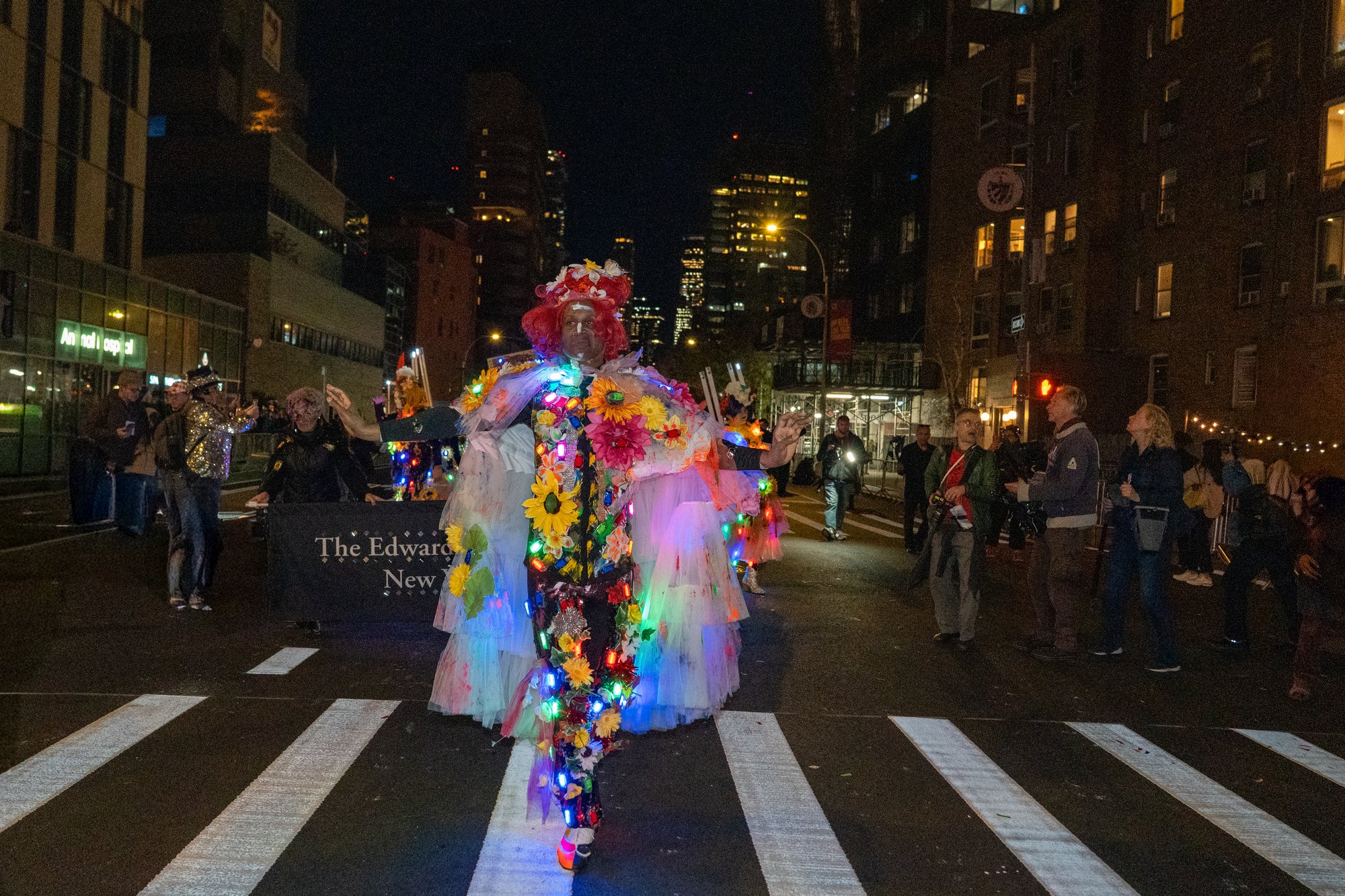
The Edward Morgan Ballet crosses Sixth Avenue. Photograph: Robin Blackstone, MD
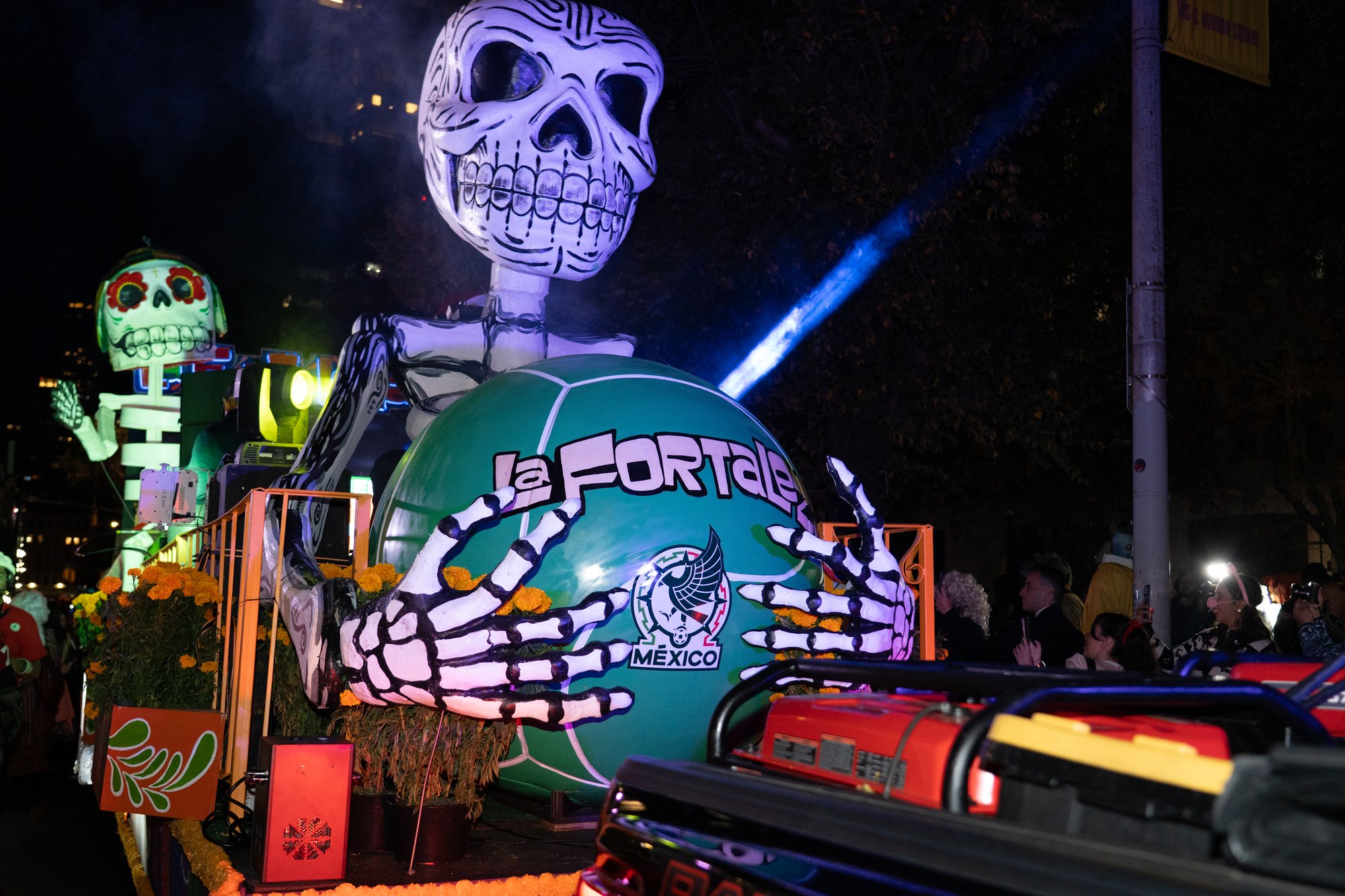
Día de Muertos float, La Fortaleza, Mexico. Photograph: Robin Blackstone, MD
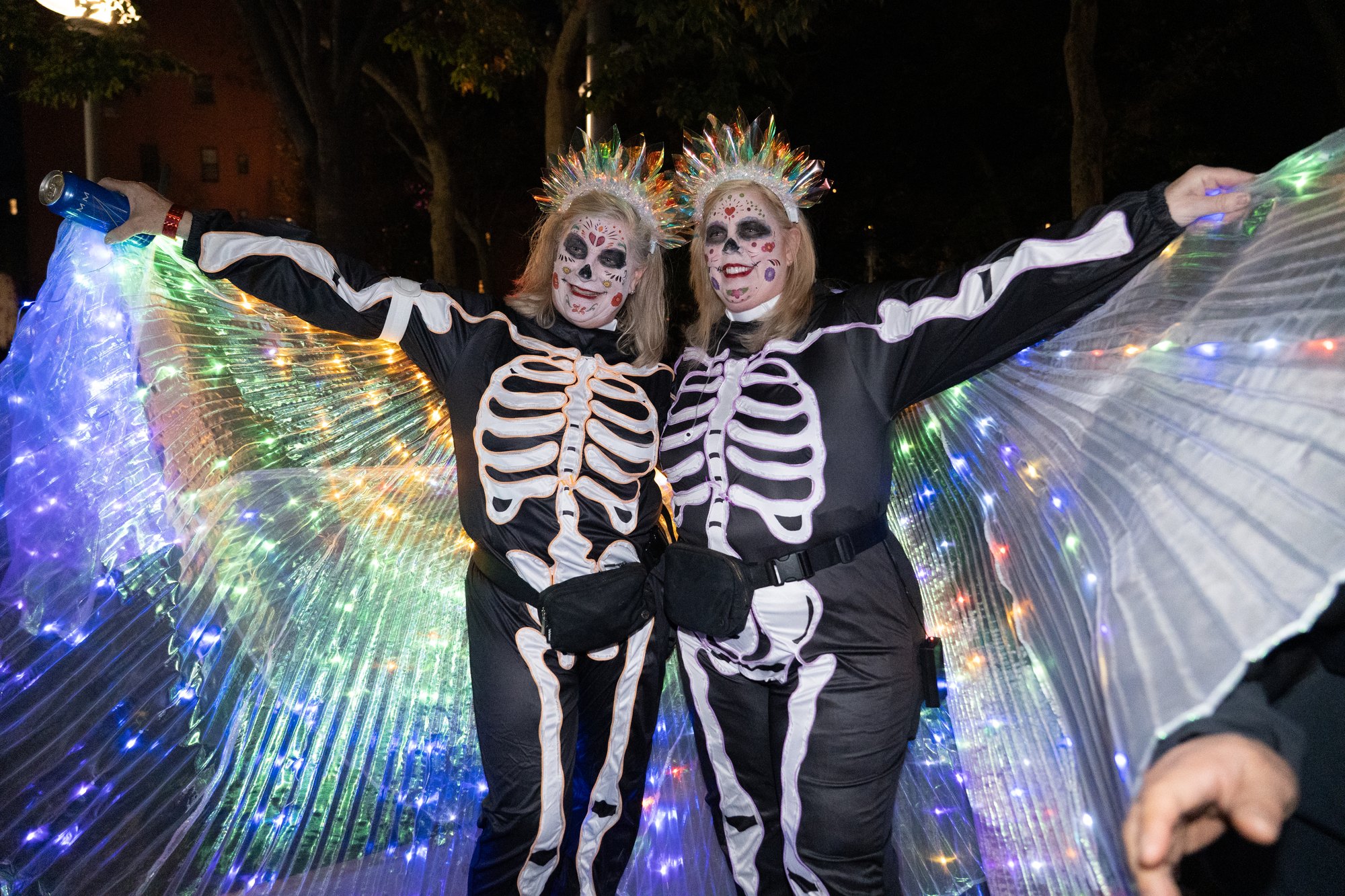
Skeletons with wings. Photograph: Robin Blackstone, MD
Culture is a vital sign
Some of us in medicine have believed for a long time that culture and environment matter to health as much as anything we do in a clinic. It has been hard to measure the way medicine counts things. Nico Pronk, President of the HealthPartners Institute, is changing that. This year his group measured every county in America twenty-seven ways and asked a machine which ones predicted diabetes. Seventeen did, almost perfectly. Movement. Distress. Who lives there. Weight. Diabetes is a place before it is a diagnosis.
Culture is a huge part of health. Not in the soft sense, the hard one. A city that comes out into the street for each other, that lets a stranger photograph its children because the children are in costume and having the time of their lives, is doing something measurable for the health of the people in it. There is no billing code for it. If there were, I'd call it H4.
The city keeps what it needs. The rest find their way out, taking what it gave them.
For years there was a bartender at Claudette, across Fifth Avenue from me at 9th Street. One night he said he was glad I had come in; he was leaving for Toronto in the morning. I didn't know you were from Toronto, I said. He had come to New York two years before to study opera. He had hoped to be good enough to sing at the Met. He wasn't. I looked at him closely for the hurt. There wasn't any. “I spent two years in the greatest opera on planet earth,” he said. “I wasn't good enough to sing, but I learned enough to teach.” They had found him a job with the opera in Toronto. He would be near his family. I sat quietly with the last martini he would ever make me and thought about my own journey, to Manhattan rather than away.
If a city offers opportunity, it translates to effort.
If a city rewards hard work and talent, it translates to excellence.
If a city asks the harder road of you, it translates to confidence.
If a city takes a new idea seriously wherever it comes from, it translates to innovation.
If a city comes out for each other one night a year, it translates to health.
After
After long hours with the camera, we end up with the News Bar's extended family at Chez Nous, under the striped awning of the Marlton Hotel on West 8th Street and photograph the group all over again. The costumes have changed with the hour. Jim, who left the News Bar as a cockatoo, is now a king with a crown, a fan and a chest full of medals. Asked which king, he says a Burger King. It is what he had for dinner.
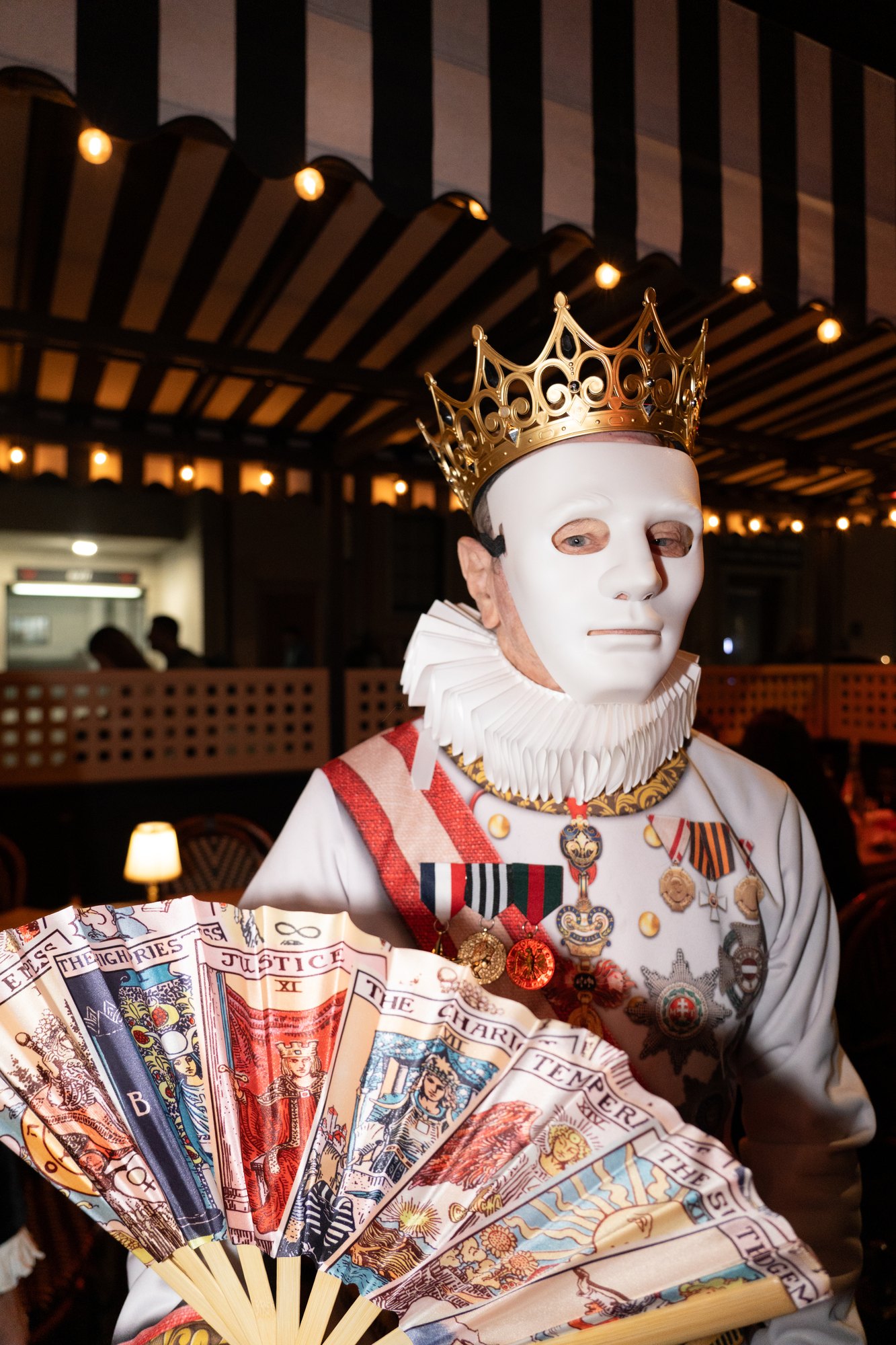
The king, after. A fan of saints and a chestful of medals. Photograph: Robin Blackstone, MD
The ghost and the witch headed home.
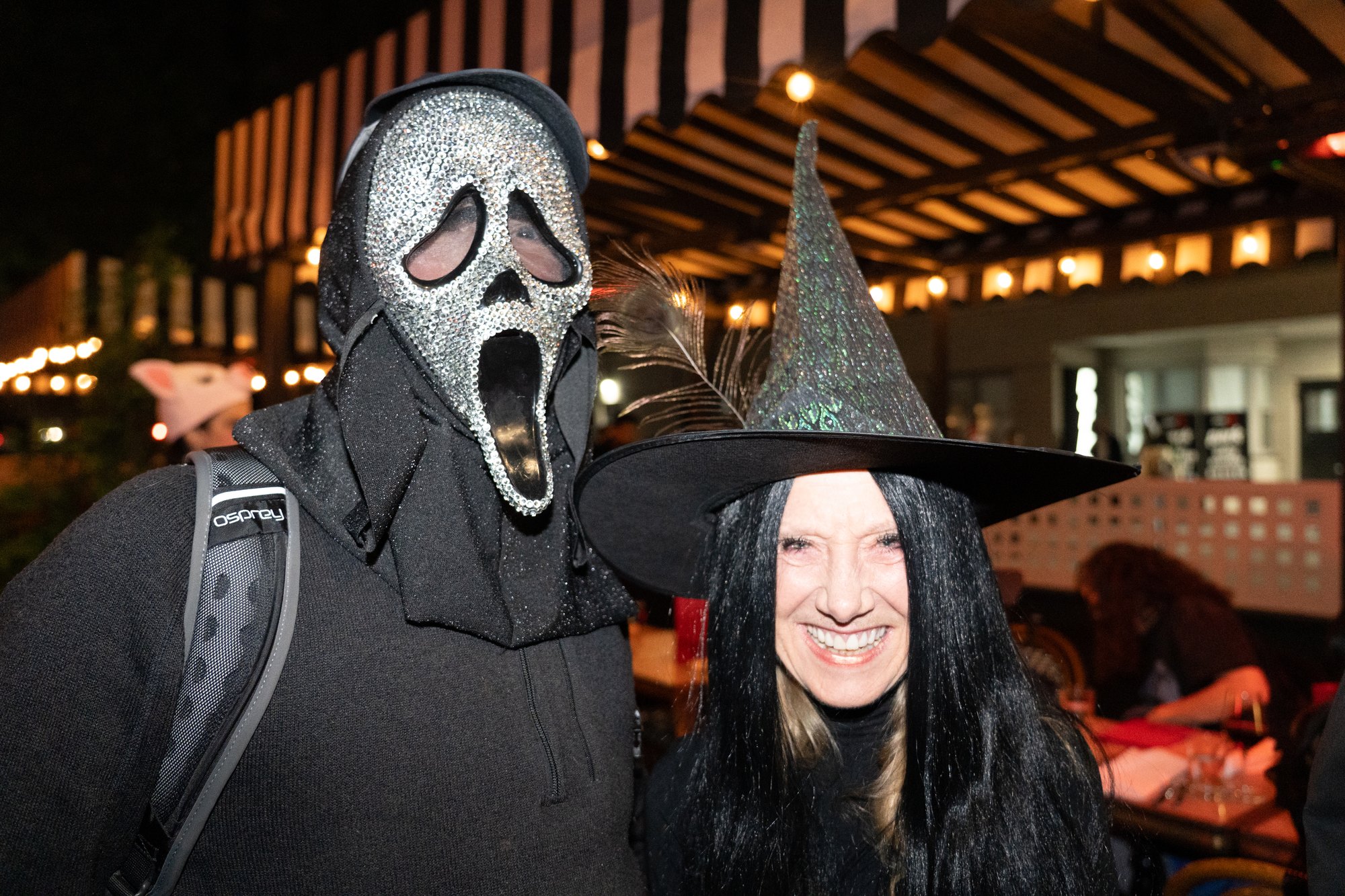
The ghost and the witch headed home. Photograph: Robin Blackstone, MD
— Robin Blackstone, MD. Photographed in Greenwich Village, New York, October 31, 2026, on an NYC press credential. Sony A7IV.
Notes and sources
1. Village Halloween Parade: history, the 2012 cancellation and 2013 revival, the 2001 phoenix, and the two-million crowd estimate — halloween-nyc.com (the parade's own site); 2026 route, start time and theme — the parade's published 2026 guide.
2. New York City population, 8,584,629 as of July 1, 2025 — NYC Department of City Planning, Population Estimates and Trends, March 2026.
3. More than one in three New Yorkers born in another country (3.1 million) — NYC Mayor's Office, Newest New Yorkers report, June 2026.
4. Manhattan land area, about 23 square miles — US Census Bureau.
5. Pronk NP, Wang S, Bergenstal RM, Carlson AL, Woodard C, Arena RA. Predicting the complex, multilevel ecology of US county-level diabetes prevalence: a cross-sectional, artificial intelligence analysis. Diabetes/Metabolism Research and Reviews. 2026;42(5). doi:10.1002/dmrr.70184