Seven Questions about Health to Ask Yourself and Anyone Who Wants Your Vote
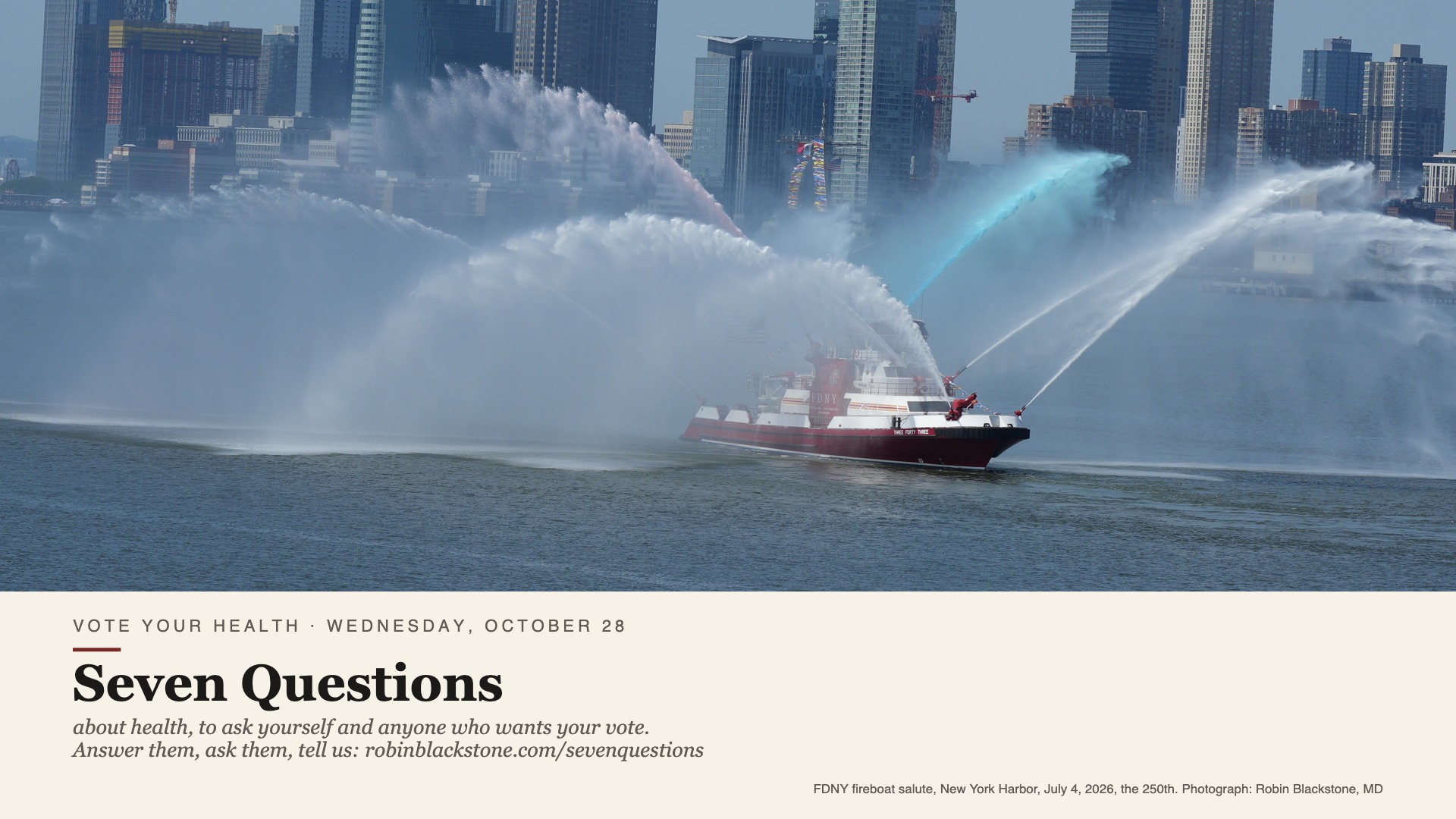
Seven Questions
about health, to ask yourself and anyone who wants your vote.
Ask them. Write down the answer. If it is a number, a name or a date, you got one. If it is only adjectives, you didn’t.
Wednesday, October 28. Six days before Election Day. Early voting is already open in many states, including New York. Your state’s dates and your polling place are on your state page at robinblackstone.com/yourstate and at vote.gov.
Monday gave us the language. Tuesday identified the people responsible for health decisions in your state. Today, seven questions that may help you decide what matters most before you vote.
In years of caring for people, I learned how much a plain question can reveal when we leave room for the answer. These begin with the human principal—the person whose body and life are at stake.
The questions are nonpartisan, and you can adapt them to the issue you care about. Answers will depend on the powers of the office. A clear explanation can be useful even when you disagree with the position.
1. Should people be able to get personalized health guidance directly from AI?
The Federation of State Medical Boards is developing recommendations on AI used with limited or no direct physician supervision. Its workgroup includes public members of state boards; STAT reports that its deliberations are confidential.[1]
Ask: What safeguards would you support, who would set them, and how would people using these tools have a voice?
2. Will you publish coverage figures and commit to measuring serious diagnostic harm?
Census already publishes state coverage estimates.[2] A national study estimated about 795,000 deaths or permanent disabilities annually from diagnostic error.[3] That estimate is not a ready-made count for your state.
Ask: When could existing figures be reported, and how could a credible state measure of diagnostic harm be developed and funded?
3. What medical debt relief could your office deliver, and how would you fund it?
North Carolina reported cancelling more than $6.5 billion in debt through conditions on enhanced Medicaid payments to hospitals, with federal approval.[4] That offers one possible approach.
Ask: Would you support that approach here, or another one? Who would qualify, what funding and approvals would be needed, and when could relief begin?
4. How will you give the public a meaningful voice on the medical board?
Medical boards license doctors and oversee medical practice. They include physicians and public members, most often appointed by governors.[5] Governor candidates can explain their approach to appointments; legislative candidates can discuss the rules governing the board.
Ask: Who would you look for, and how would public members influence decisions?
5. How do you expect coverage here to change next year, and what will you do?
CBO projected about 10 million additional uninsured people nationally in 2034 from the 2025 reconciliation law.[6] For a voter, the nearer question is how coverage in their state could change in 2027.
Ask: What is the state forecast, what are its assumptions, and what difference is your proposal expected to make?
6. Which services should nurse practitioners and pharmacists provide independently?
When a rule requires another clinician’s approval, the question is what it contributes to safety and what it costs in money or waiting.
Ask: Which service and restriction do you have in mind, and what evidence would guide your decision? How should AI support these professionals, and what safeguards and human oversight should be required?
7. Which barriers would you work to remove when people need care across state lines?
Care across a state line can mean a telehealth visit, seeing a specialist or continuing treatment after a move. The relevant rules and decision-makers depend on the situation.
Ask: Which barrier would you tackle first, and who would you need to work with?
A question of your own
You might choose one of these questions, or adapt it to a decision your family is facing. Contacts for the relevant offices are at robinblackstone.com/yourstate.
If you receive an answer you would like to share, I would be interested to hear it. You can use the response form below. A copy or link would help preserve what was said. If I share a reply, I will check it and leave your name out.
For voting dates and locations, check your state’s official election website. Start at vote.gov.
Answer them yourself
Two minutes. Results by state on Friday, with no names.
Then ask, and tell us what they said
Write down the answer. If it is a number, a name or a date, you got one. If it is only adjectives, you didn’t.
Your state page at robinblackstone.com/yourstate has the official pages to reach your governor, your legislators and your members of Congress; your state’s election site lists everyone on your ballot. Ask one question, write down the answer, and record it here. Friday we publish what the people who want our votes said, office by office, without party labels and without your name.
Where I stand
I do not belong to a political party. I founded Blackstone Health and the H4 Alliance and am developing Doctor AI. I also write books about these issues. The policies I advocate could affect those projects. No one is paying me to write this.
Tomorrow: Your Health, Your Voice, Your Vote—five commitments worth asking about, and who could help make them happen.
If these questions would be useful to someone you know, you are welcome to share them.
#VoteYourHealth #FirstOpinion
Get each piece by email. Subscribe free on Substack: robinblackstone.substack.com