Do You See Me, America?
By Robin Blackstone
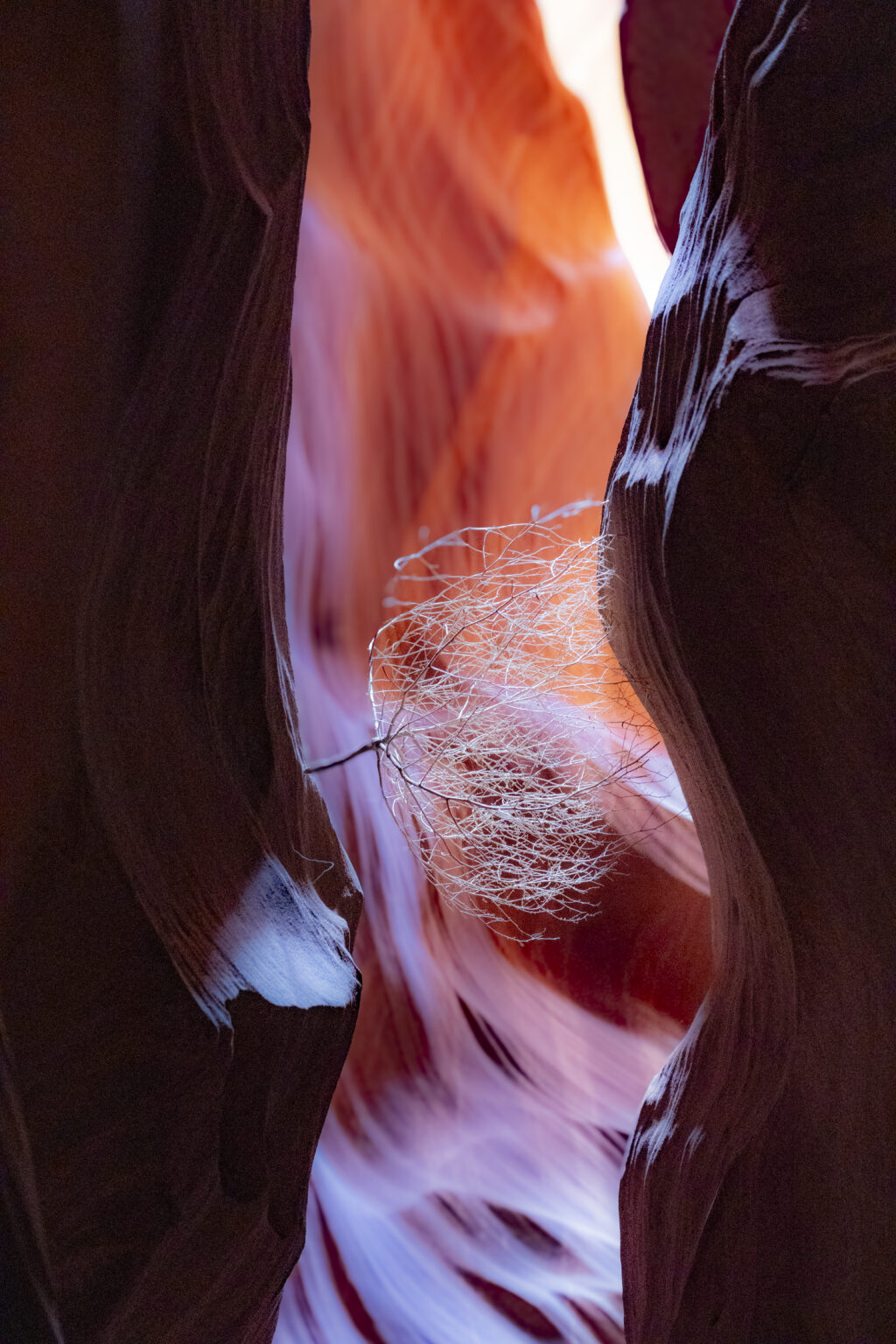
Antelope canyon is one of the most photographed place on earth, which should have made me distrust myself. Everyone who enters it makes the same pictures: the wave of sandstone, the shaft of light, the walls the color of embers. I made those pictures too. Then I came around a bend and stopped, because ten feet above the canyon floor, wedged between the two walls, was a tumbleweed.
It hung there perfectly still. It was not falling. It was not rising. It had been blown in from the desert above — days ago, years ago, there was no way to know — and it had drifted down between the narrowing walls until the canyon held it by friction alone, a sphere of silver wire suspended in stone that was glowing orange and rose around it. The light made it beautiful. The light makes everything in that canyon beautiful. That is what the canyon does.
Here is what I knew about tumbleweeds, standing there, from a childhood spent at the edge of this desert.
A tumbleweed is not a plant. It is the dead part of a plant. The Russian thistle grows green and rooted all summer, and then, when the season turns, it snaps off at the stem by design. The dead skeleton is the dispersal mechanism: it tumbles across the country scattering seeds by the tens of thousands, and the more broken it gets, the farther the seeds go. It cannot stop. Stopping is not in its design. It rolls until something catches it — a fence, an arroyo, a canyon — and even then it is not finished, because the wind works on whatever it has caught, and the seeds keep falling.
And it is not from here. The icon of the American West — the thing the movies taught us to read as freedom — arrived in the 1870s in contaminated shipments of flax seed and spread because nothing on this continent had evolved to stop it. We imported it, it broke from its root, and its dead body became the most efficient distribution system the desert has ever seen.
I stood under it for a long time.
Because I know another structure like this. It also broke from its root — the root was care, the unhurried hour between one human being and another — and the break was by design, because the dead part travels better. It also cannot stop; stopping is not in its design either. It also scatters its seeds wherever it tumbles: the billing codes, the prior authorizations, the fifteen-minute visits, the portals that answer instead of people — tens of thousands of seeds, and the more broken the thing gets, the farther they spread. It is also an import, in its way: assembled from pieces that were never evolved for this land’s actual life, and unstoppable because nothing in our politics had evolved to stop it.
And it also hangs, right now, in a canyon of astonishing beauty — the hospitals, the science, the genuinely miraculous medicine — wedged, suspended, neither falling nor rising, held in place by friction alone. The light we work in makes it look permanent. The light makes everything in that canyon look permanent.
But I grew up beside these canyons, and I know what made them.
Water made them. Not the patient trickle — the flash flood: rare, sudden, total, rearranging in an afternoon what the stone thought was settled. The canyon is not a monument. It is a record of every time the water came back. And the water always comes back. When it does, it does not negotiate with what is wedged in its path. The walls will still be there afterward, more beautiful for the carving. The tumbleweed will not.
I made the photograph and walked out of the slot into the flat hard light of the desert, where the living thistles were green at the roots, hoarding their seeds, waiting for the season to turn.
The seed is not the enemy. The seed is just the future, asking what we intend to grow.