The 28th Amendment
The 28th Amendment: the Right to Health
“The right to health, including equitable access to timely, comprehensive, and universal health care, shall not be denied or abridged by the United States or by any State.”
Amendment XXVIII · The Right to Health Care
A note on the name. Several movements have proposed a “28th Amendment” — for equal rights, and for campaign-finance reform. This is not those. This is one proposal, for one thing: a constitutional right to health care.
What it guarantees
What it abolishes
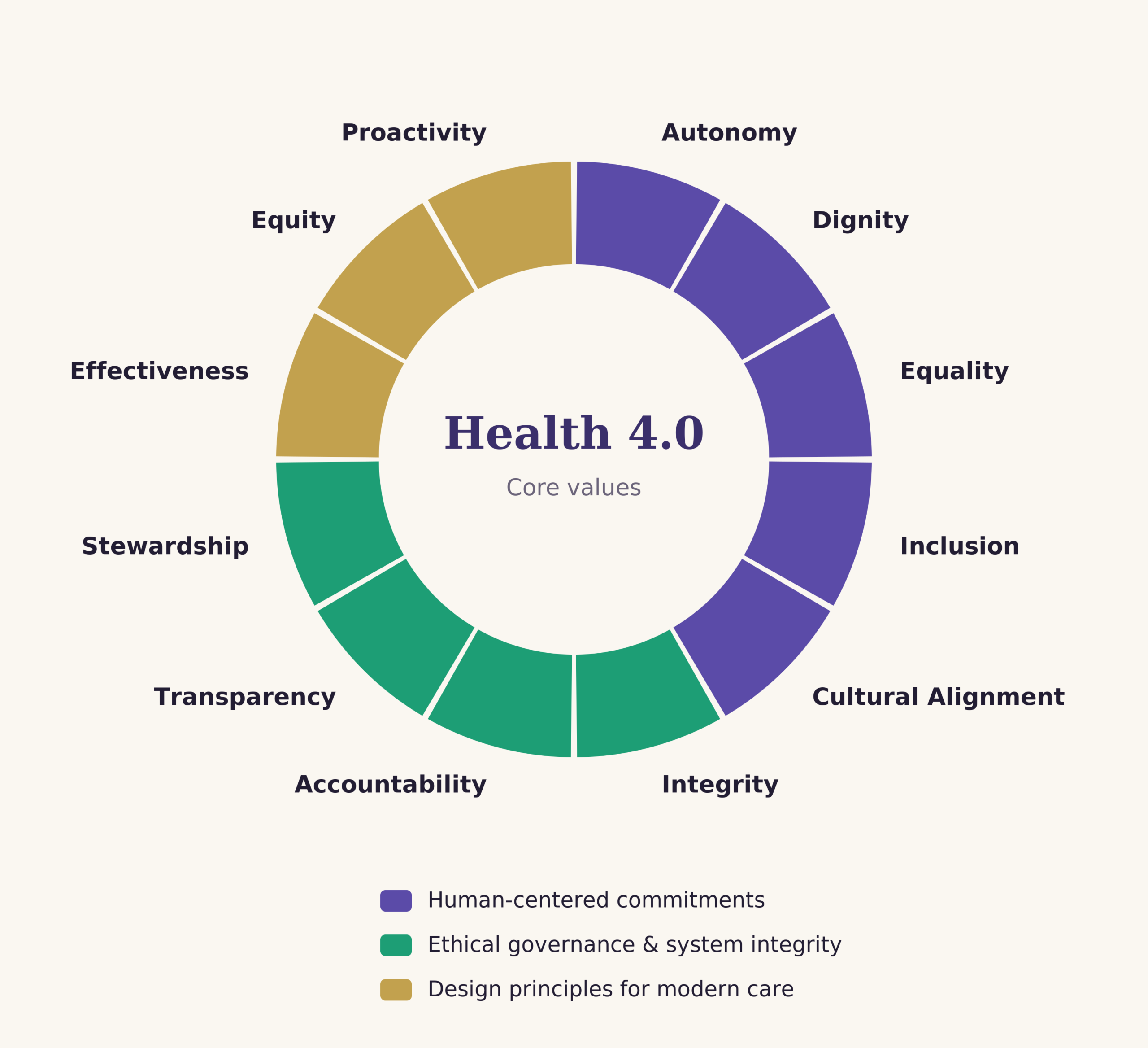
One monthly fee for comprehensive coverage — the goal. Stewarded by an independent public trust with powers comparable to the Federal Reserve. “True autonomy means freedom from the fear of medical bankruptcy.”
How a once‑impossible idea becomes overdue
Health is a right, not a market privilege.
A 28th Amendment gives a 21st‑century system its moral and legal foundation.
Health 4.0 transforms health.
AI, data, and culture move us from rescue care to proactive, preventive health.
Trust is the currency of the new health economy.
Transparency, data ownership, and ethical AI heal the relationship between people, professionals, and institutions.
A self‑sustaining architecture for national health.
The H4 Alliance unites public purpose with private innovation, anchored by the Health Commons Endowment.
Doctor AI brings precision and scale to every person.
A personal health agent that protects privacy and frees clinicians to be human.
Culture is medicine.
Systems that respect regional, tribal, and community identity earn better engagement and outcomes.
The economy of health replaces the economy of illness.
Realign incentives around outcomes and wellbeing, redirecting trillions in waste.
Autonomy is the heart of dignity.
Health 4.0 restores decision‑making power to the individual through transparency and moral design.
Why we call it the 28th Amendment
The Constitution has twenty‑seven amendments. The twenty‑eighth has not yet been written — and more than one movement is competing to claim it. Some would use it to guarantee equal rights regardless of sex; others to get money out of politics. Those are worthy fights. They are not this one.
We use the number deliberately. It signals that the right to health belongs where a nation’s most fundamental commitments live — not in a statute that shifts with each Congress, but in the Constitution itself. A right that can be repealed by a budget is not a right. Calling it the 28th Amendment says plainly what it is: the next thing America must guarantee, at the highest level of law.
So when we say the 28th Amendment, we mean one specific thing: the right to health care. Not equal rights. Not campaign finance. Health.
How the 28th Amendment happens
The Constitution’s Article V gives two routes. Congress can propose an amendment by a two-thirds vote of both chambers, or two-thirds of the state legislatures can call a convention to propose one. Either way, nothing becomes law until three-fourths of the states — thirty-eight of fifty — ratify it. That is a deliberately high bar: the Constitution changes only when the country has genuinely changed its mind.
It has happened twenty-seven times. Some amendments moved fast — the 26th, lowering the voting age, was ratified in about a hundred days. The 27th took two hundred and two years from proposal to ratification. Speed is not the point; consensus is. Every amendment began the same way: as an idea considered impossible, argued into the mainstream by people who refused to stop making the case.
That is the honest path for the 28th Amendment. First the argument — in books, in research, in conversations like the ones on this site. Then the movement, as families, clinicians, employers, and states recognize that a right that can be repealed by a budget is not a right. Then the votes. The work of this generation is to move the right to health from unthinkable to obvious. The Constitution has a process waiting for when it gets there.
Health care is not a privilege purchased through wealth or employment, but a constitutional right grounded in life and liberty.
Health is how the pursuit of happiness becomes possible.
The future of health will be authored by someone. Pick up the thread.