She Gave the Answer First
On the ghats of Varanasi during Dev Deepawali, November 2024
By Robin Blackstone
The first thing she did was lift a leaf to her face.
She was sitting at the base of a banyan, an old woman in a red bandhani sari with a pattern of small white squares, two heavy silver bangles stacked on each wrist. Her hands were in her lap until I lifted the camera. Then one hand reached up — slowly, almost casually — pulled a leaf from the branch above her head, and held it across the lower half of her face. She did not look at me. She did not look away from me either. The leaf was her answer to a question I had not yet asked, and she gave the answer first.
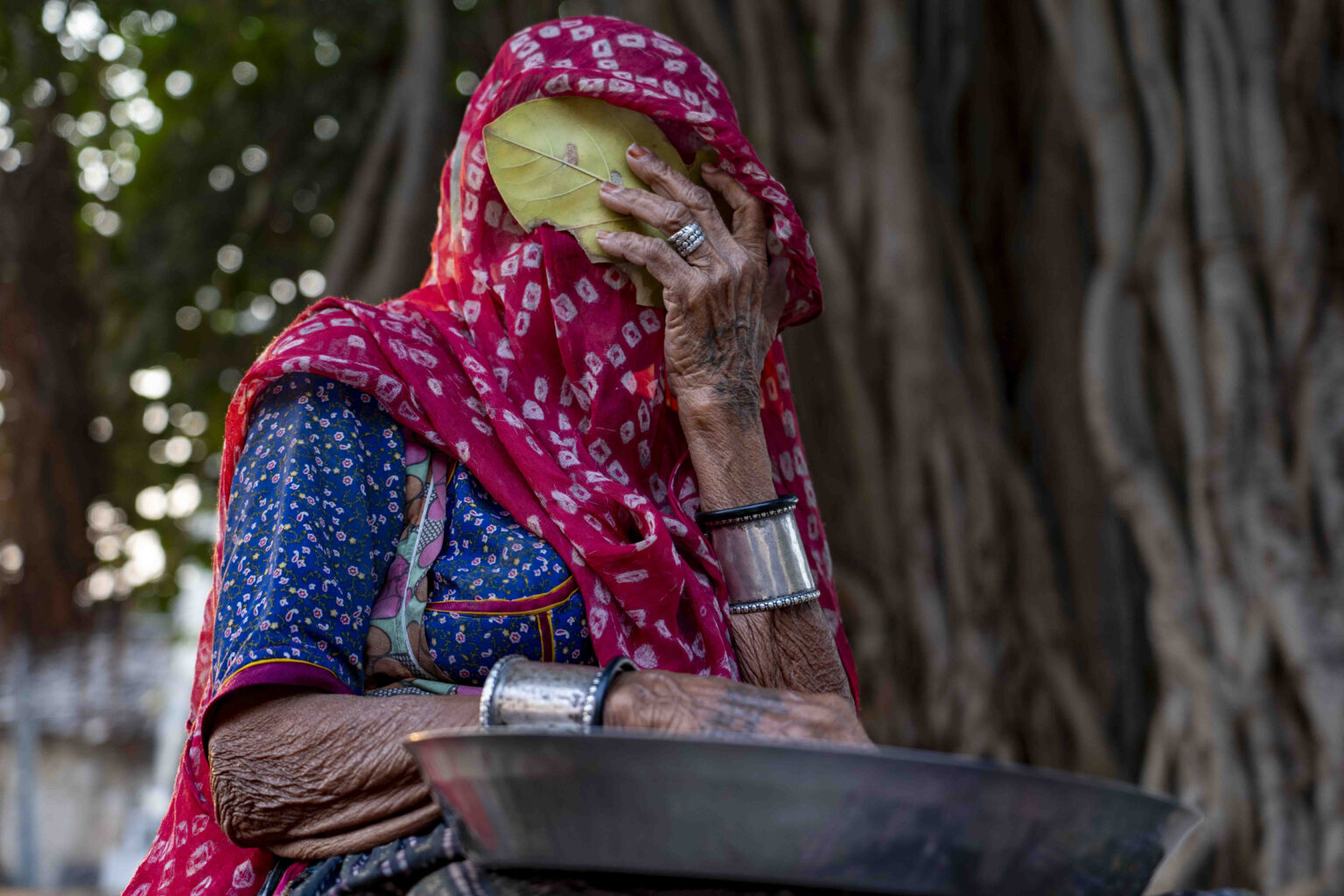
I made the photograph anyway. The leaf is in it. Her eyes are above the leaf. The hand on the leaf is knotted with arthritis or work or both; her wrists are weighted with the silver. The banyan roots behind her are like a forest. She is composed inside the gesture in a way that took me, at first, several minutes to understand.
I think now that it took me longer than that. I am still working it out.
I was on the ghats of Varanasi for Dev Deepawali, in November of 2024 — the night, fifteen days after Diwali, when more than a million oil lamps line the ghats of the Ganges and the city goes incandescent under a full moon. Varanasi is the kind of place that should have made me distrust myself. It is among the most photographed cities on earth. Every tourist with a camera, every documentarian with a budget, every photojournalist sent on assignment has produced the same essay: the smoke from the pyres, the bells, the river ancient as time. I had read that essay so many times I knew the sentences before I read them. I had not yet decided what mine would be.
The leaf was the first thing that made me think the essay might be possible.
*
What I had not understood, until that week, was how much labor the festival rests on.
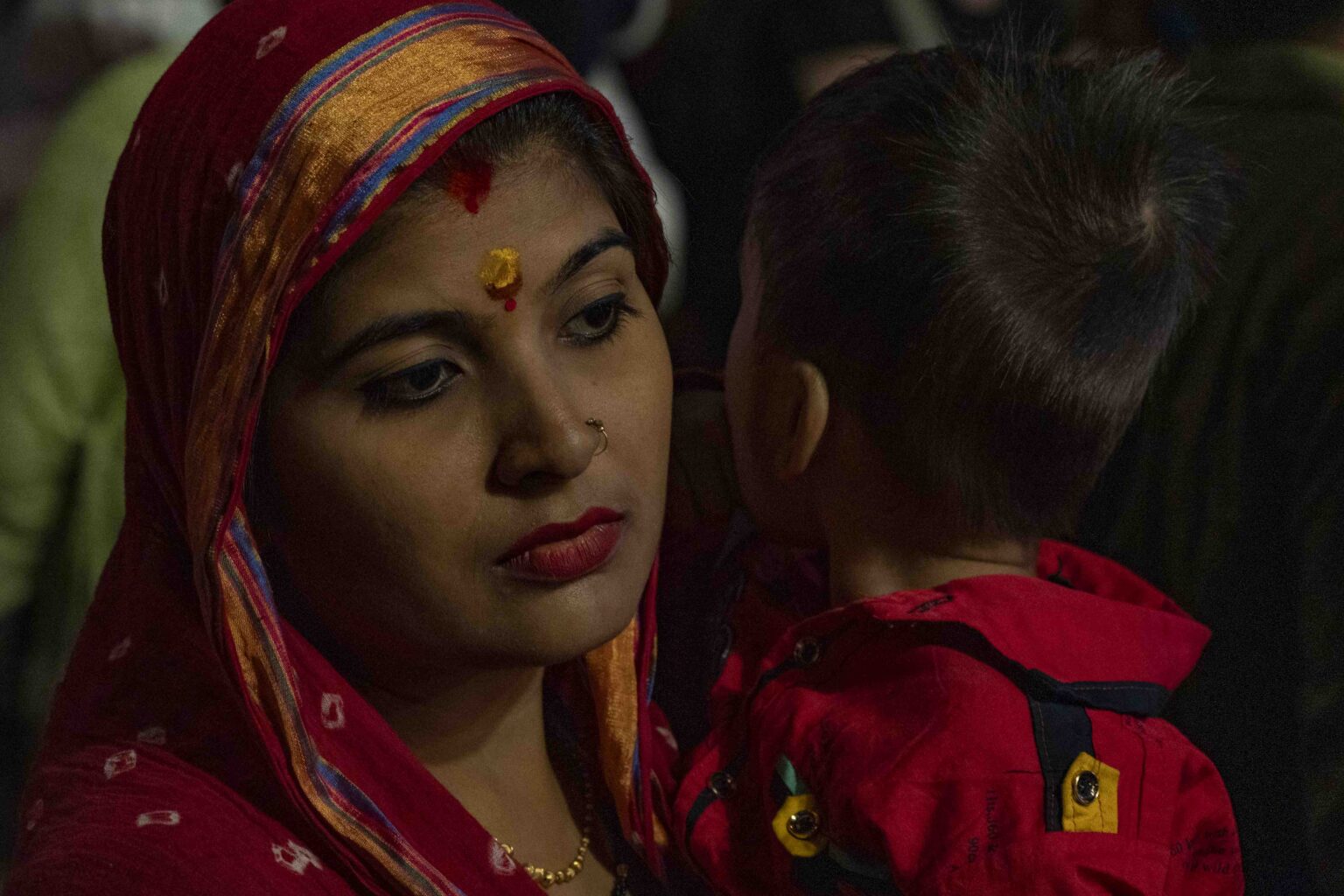
The lamps that line the ghats on Dev Deepawali do not arrive there. They are made by women in courtyards through the autumn, sold to lamp-sellers, sold again to vendors on the ghats, lit by hand by boys and old men paid by the hour. The flowers that float down the Ganges in cupped leaves are made by women who sit on the steps of the ghats from before dawn, folding leaves into cups, pinning marigolds inside them, selling them five at a time to pilgrims for a few rupees. The pilgrims have come on overnight buses from Bihar, from Rajasthan, from villages whose names do not appear on the maps tourists buy. Their saris are dust-stiff from the road. Their feet are dust-stiff from the road. Among them, at the edge of the lamplight, a young mother in a red veil carried her son, lit by other people’s lamps.
*
The festival is a marketplace, and the marketplace is a livelihood, and the livelihood is what holds the festival up.
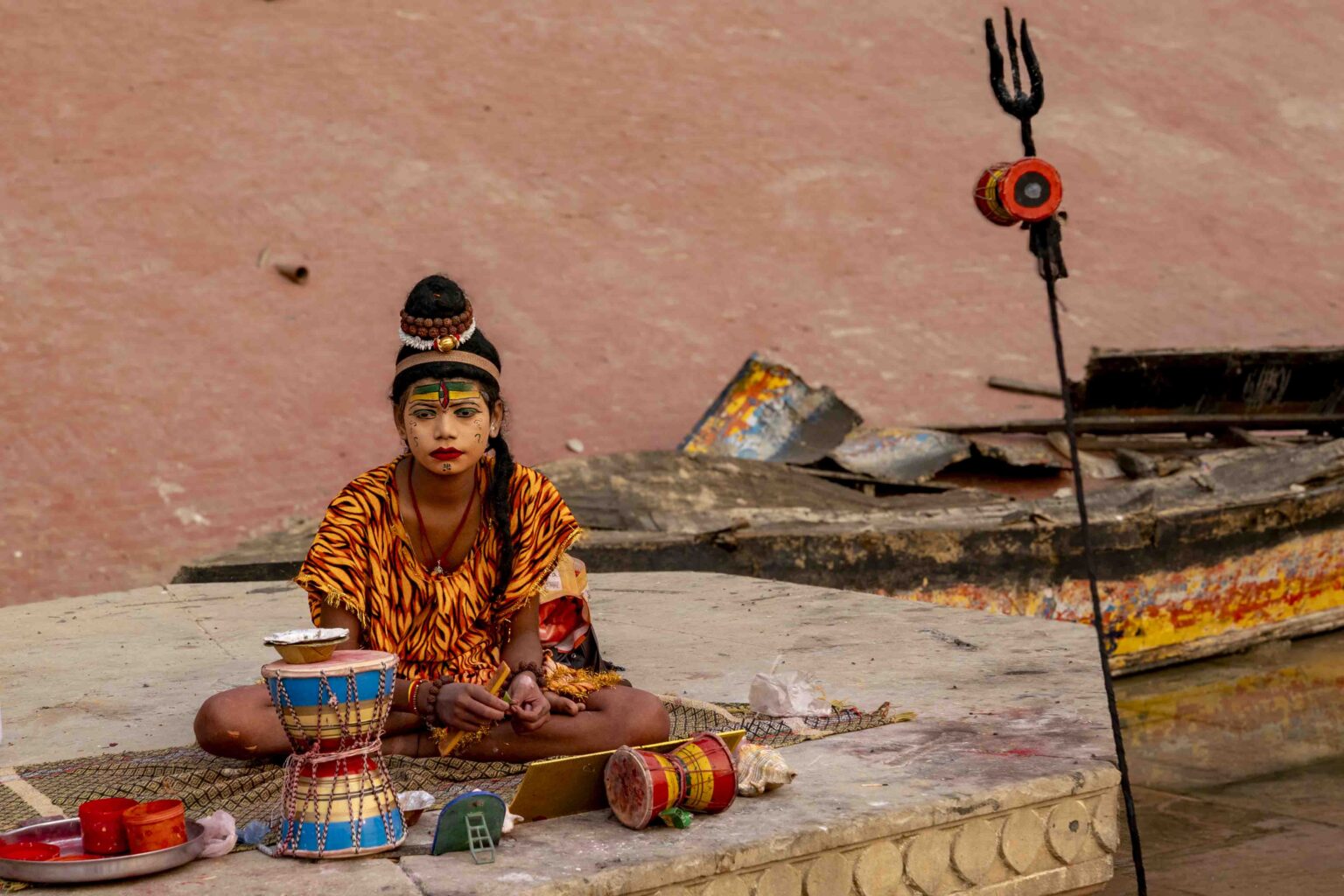
A few yards from the leaf-woman’s banyan I watched a child of maybe nine years old make herself into a god. She had been painted in stripes of yellow and red across her forehead, her tiger-print kurta clean and oversized at the shoulders, her hair tied above her head and bound with a rudraksha crown. A small painted damaru lay in front of her, and a metal trishul was stuck into the ground at her side. She sat on a mat the size of a folded newspaper. When tourists with cameras stopped, she pressed her hands together and held her face very still, and after each photograph she looked up at them — directly at them — and a parent watching from a few feet away nodded almost invisibly to the rate. Most of them paid. Some did not. She did not move in either case.
*
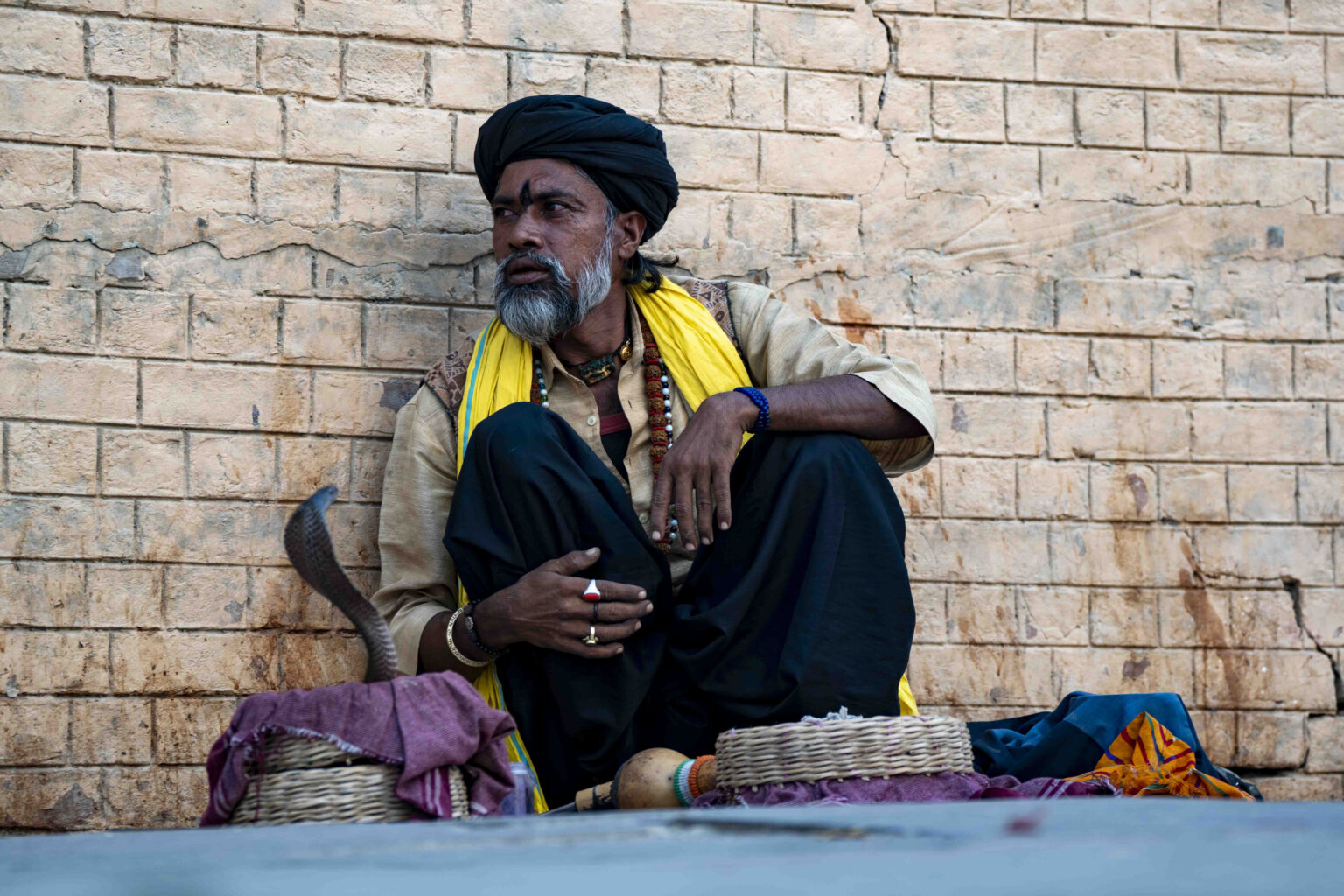
A few ghats over, a man in a black turban with a yellow scarf around his shoulders sat with his back against a sandstone wall and a hooded cobra rising slow from a wicker basket between his knees. He had been sitting in the same spot, I learned later, for thirty years.
*
What the river makes possible is what the city is for.
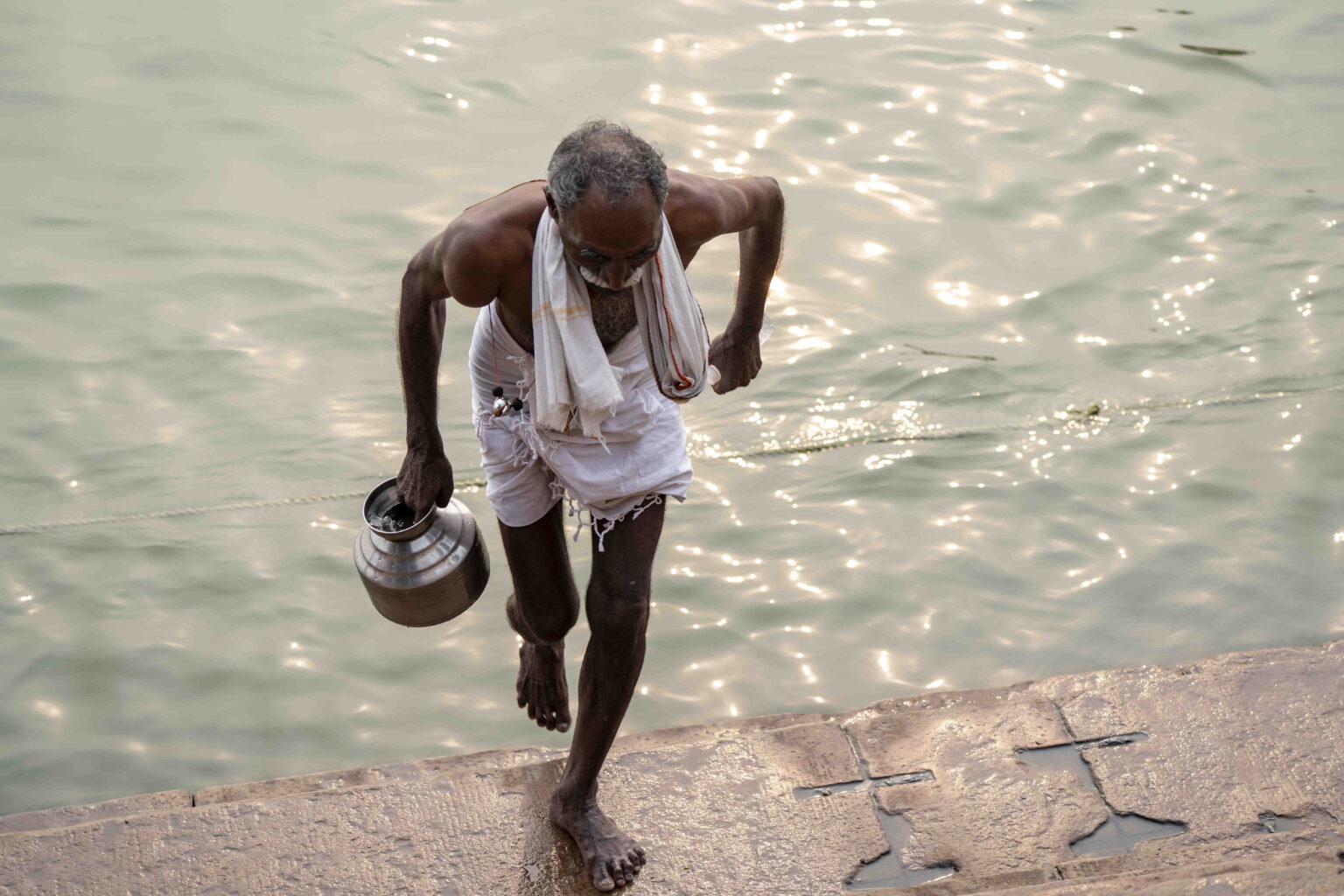
In the early morning, before the lamps were lit and before the tourists were awake, an old man stepped up onto the ghat from the water with a brass lota in one hand and a wet cotton wrap around his waist. The river was still. The sun was low. The water behind him was sequined with the kind of light photographers wait for. He was emerging from his ablution. He had probably been doing the same thing on the same step for sixty years. He did not look at me. There was no need to. The work between us was already settled: I was there, he was there, the river had always been there, and a photograph was either going to be made or not. I made it.
*
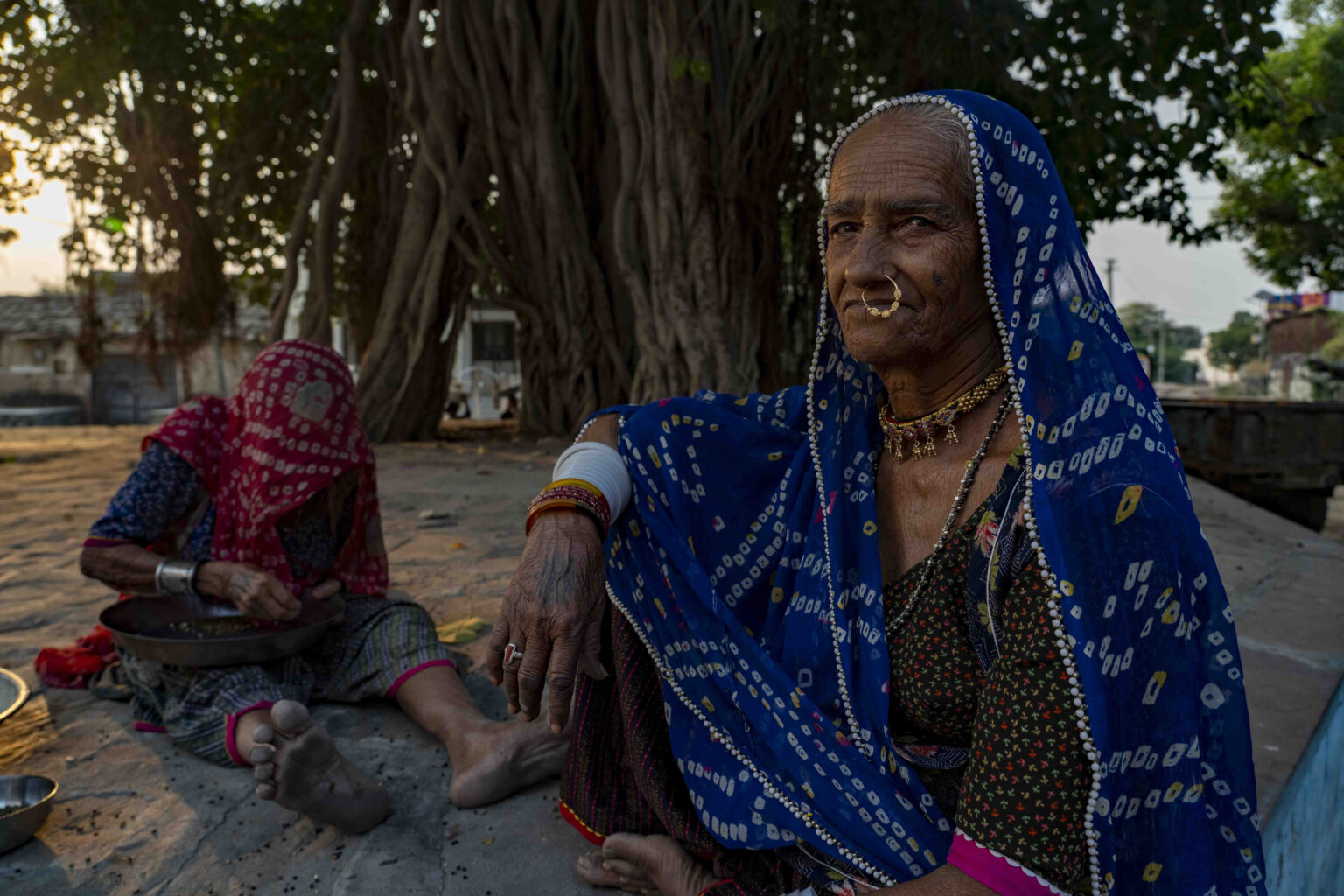
In the late afternoons the same step was occupied by older women — women older than the leaf-woman by a decade — sitting in the shade of the banyans with their daughters and granddaughters around them, husking grain, threading marigolds, talking about the prices of things. They were all in bandhani; all in colors I did not know there were words for. They had come, I learned through a granddaughter who spoke a little English, from villages in Rajasthan two days’ travel away, on a pilgrimage they would make again in five years if they were still alive. I asked the oldest one whether I could photograph her. She studied me for a long moment and said something the granddaughter rendered as: “Yes, but I will choose where I look.” I made the photograph. She is looking just past my left shoulder, at her sister, who is working a brass pan in the dust.
*
The cremation ghats are upstream. You smell them before you see them.
I went to Manikarnika at sunset of the second day and stayed until the moon was up. I will not describe the pyres in detail. There is no version of that prose that does not slide toward exposure. What I can tell you is that the fires are tended by men who have inherited the work for many generations, and that the wood is bought, and that the priest is paid, and that the family of the dead person stands in the smoke for as long as it takes for the body to be released to the river. What I made photographs of was the standing, not the burning. The standing is what the day asks of you.
In one of those photographs there is a man, about sixty, in a gray-green jacket with a white scarf draped over one shoulder. He is in the foreground, in profile to a fire I have left to smolder along the right edge of the frame. The men around him — younger, older, in white wraps and turbans, a woman at the far left in a red veil — are looking at the pyre or at each other or at nothing. The man in the gray-green jacket is looking at me. He has turned his head a quarter-turn from the fire and his eyes have found the lens and held it. He is letting me see him. Behind him, the wood is doing what wood does. The photograph would be unmakeable without the quarter-turn of his head.
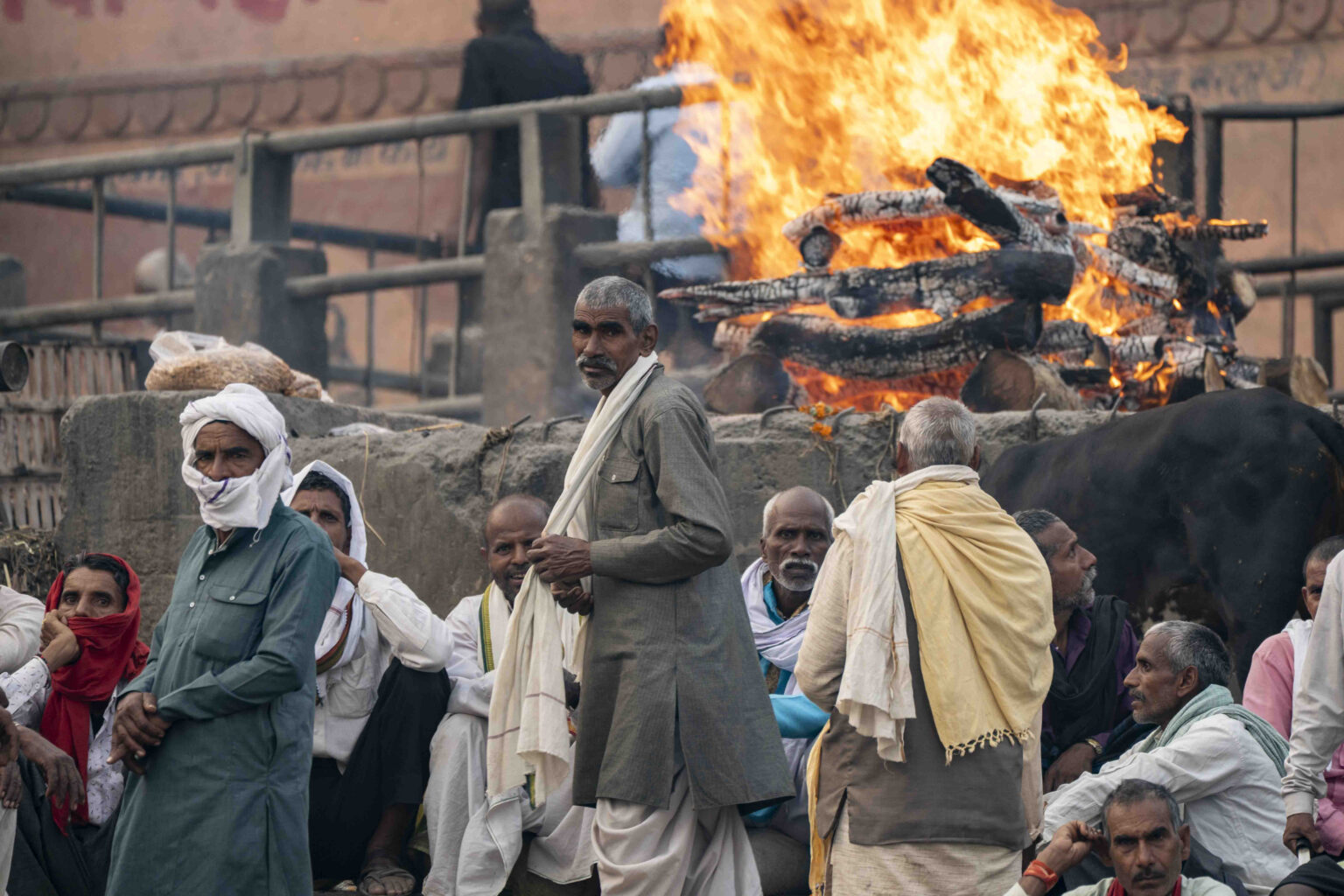
I have looked at that photograph many times. He is the consent on which the rest of the picture rests.
*
The leaf-woman, the girl as Shiva, the man at the river, the woman who chose where to look, the man at the pyre. Each of them, in one form or another, did the same thing. They asked, with their hands or their eyes or the angle of their heads, what part of themselves the camera would be permitted, and then they answered. Some refused. Some agreed in part. One of them, on the smoke-stained step at Manikarnika, agreed to be seen at the place where most people would have looked away.
I went to Varanasi to see what was there. What the people on the ghats taught me, in a language I could not speak but could follow, was that what is there is what they choose to show, and that the only photograph worth keeping is the one made inside that choosing.
The leaf is still in my notebook. She is in every other picture.