Five Gifts
What to Ask For This Holiday
The Five Gifts for Your Health, and who can give them.
Thursday, November 5, 2026. Two days after the vote.
The gift you had already paid for
The United States developed the Global Positioning System with tax dollars. For twenty years only the military could use it fully. The public got a deliberately blurred version of its signal, accurate to about the length of a football field. Then, like magic, on May 1, 2000, the government turned it on for public use. That morning the blur was turned off. Nobody was charged. Nothing new was built. Every receiver in the country became ten times more accurate, and every map on every phone since has been that gift: a thing the public had already paid for, finally handed over.
That is the oldest kind of gift. Not charity. Giving people what was already theirs.
First, the premise
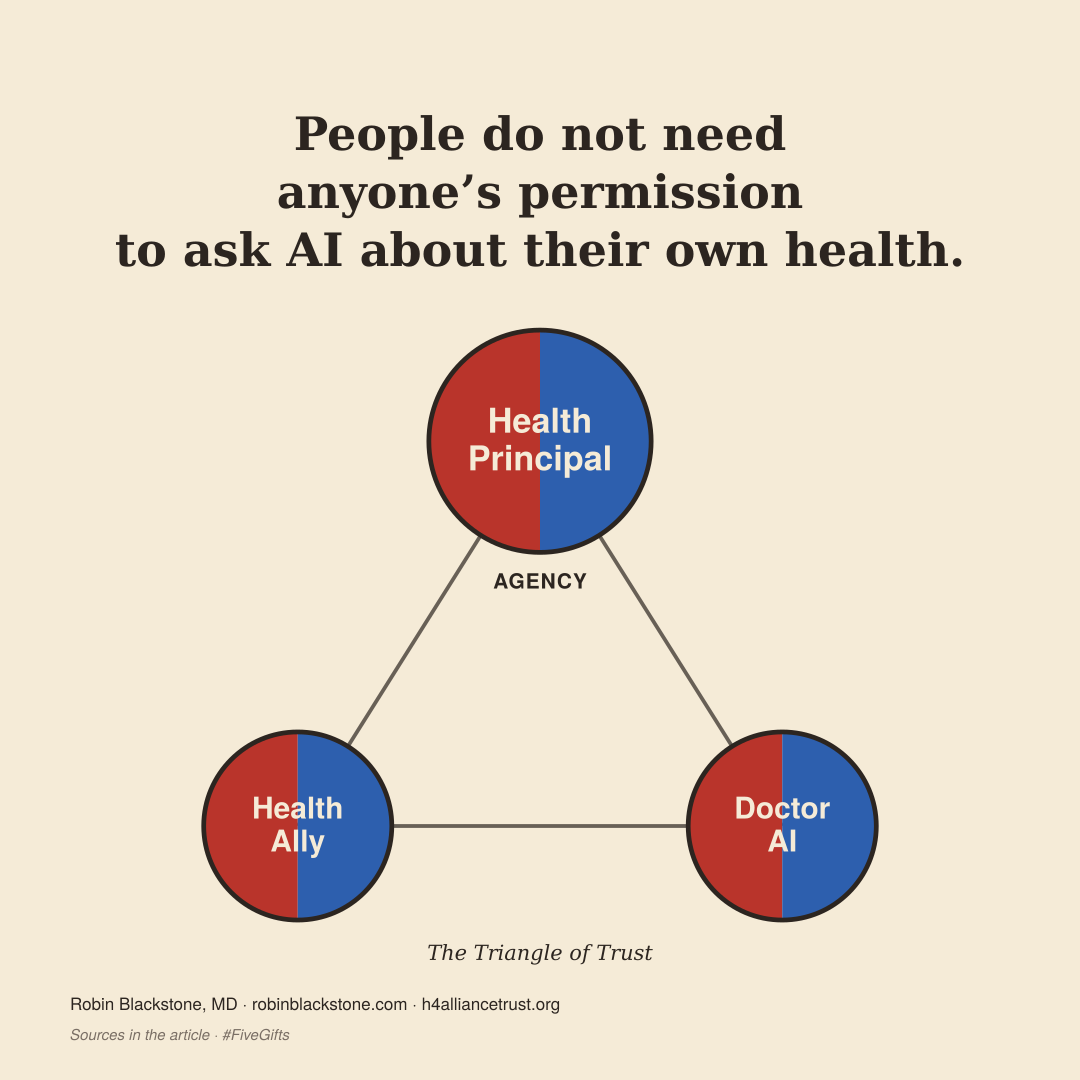
People do not need anyone’s permission to ask AI about their own health.
One in three American adults asked an AI about their health in the past year. That is the crux: when will we put the human principal, with autonomy, at the center of the system? Yes, they need a human health ally. Truthfully, that could be a doctor, a nurse, or a community health worker, depending on what they need. What is essential, and what they should not be censored from using, is AI. Whether a machine’s answer is speech is for the courts; your right to ask a question and read the answer is older than the machine. Doctor AI, the digital health ally, can give people a specificity and precision we have never been able to provide before. It can bring their culture, their preferences in how they deal with their health, and the advantages and constraints of where they live to bear on their health, under their own autonomy.
The day of needing a nanny is long past.
The Five Gifts
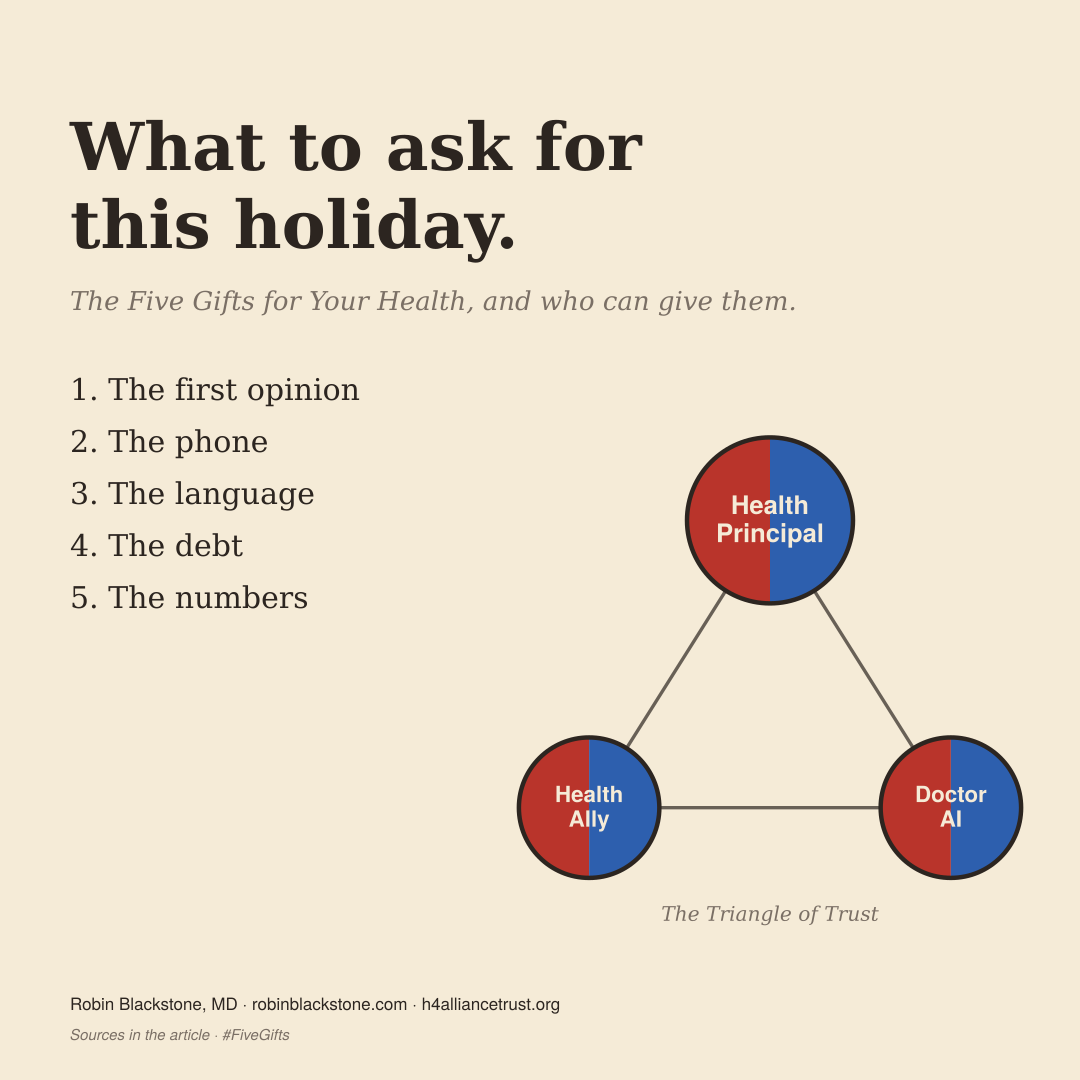
Five gifts define a safety net for Americans and their health. Each already paid for, by you, in taxes or at the register. Each in someone’s hand to give. Tuesday night decided who some of those people are. None of the five needs an act of Congress. All five could be given before the holidays.
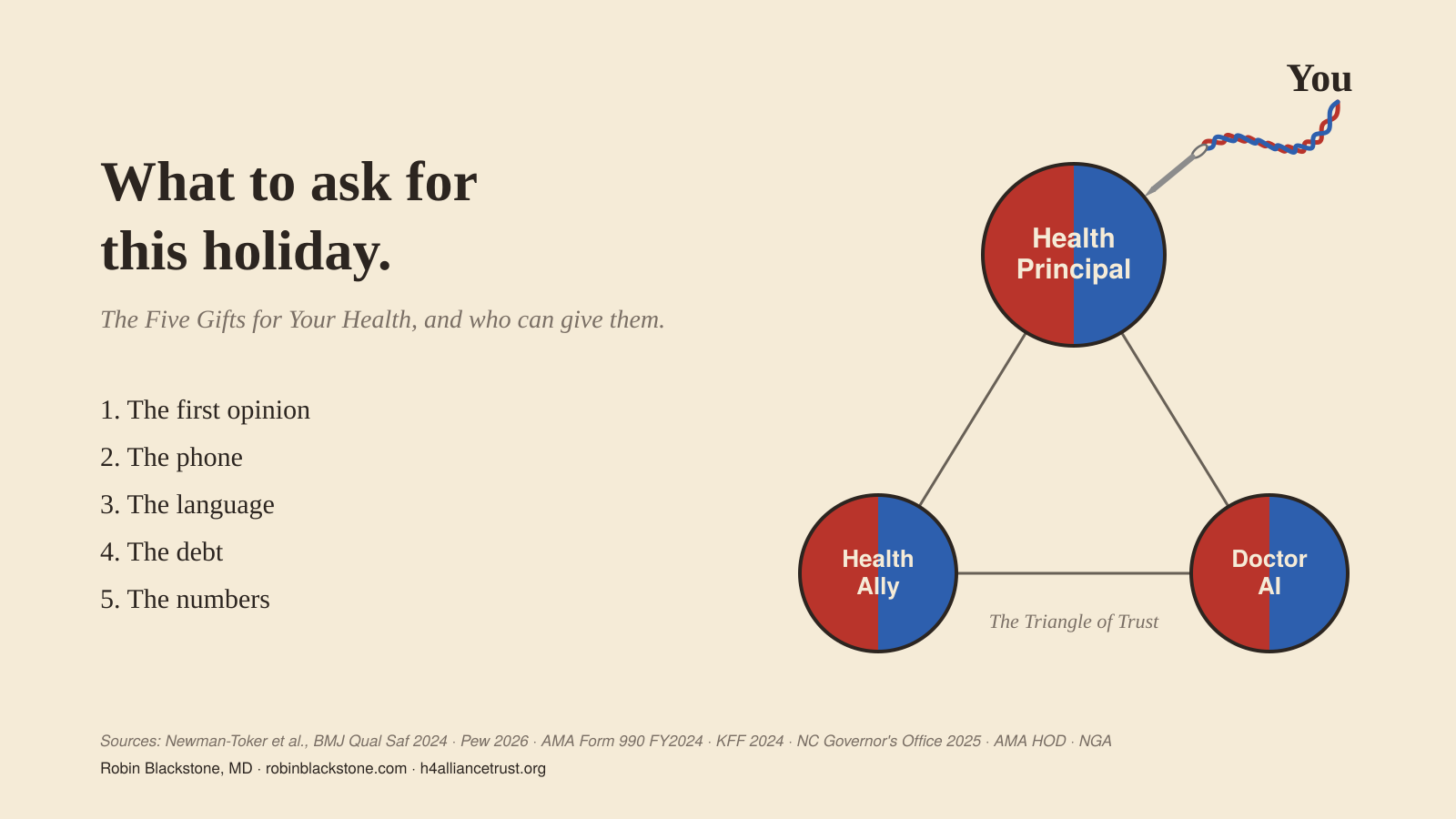
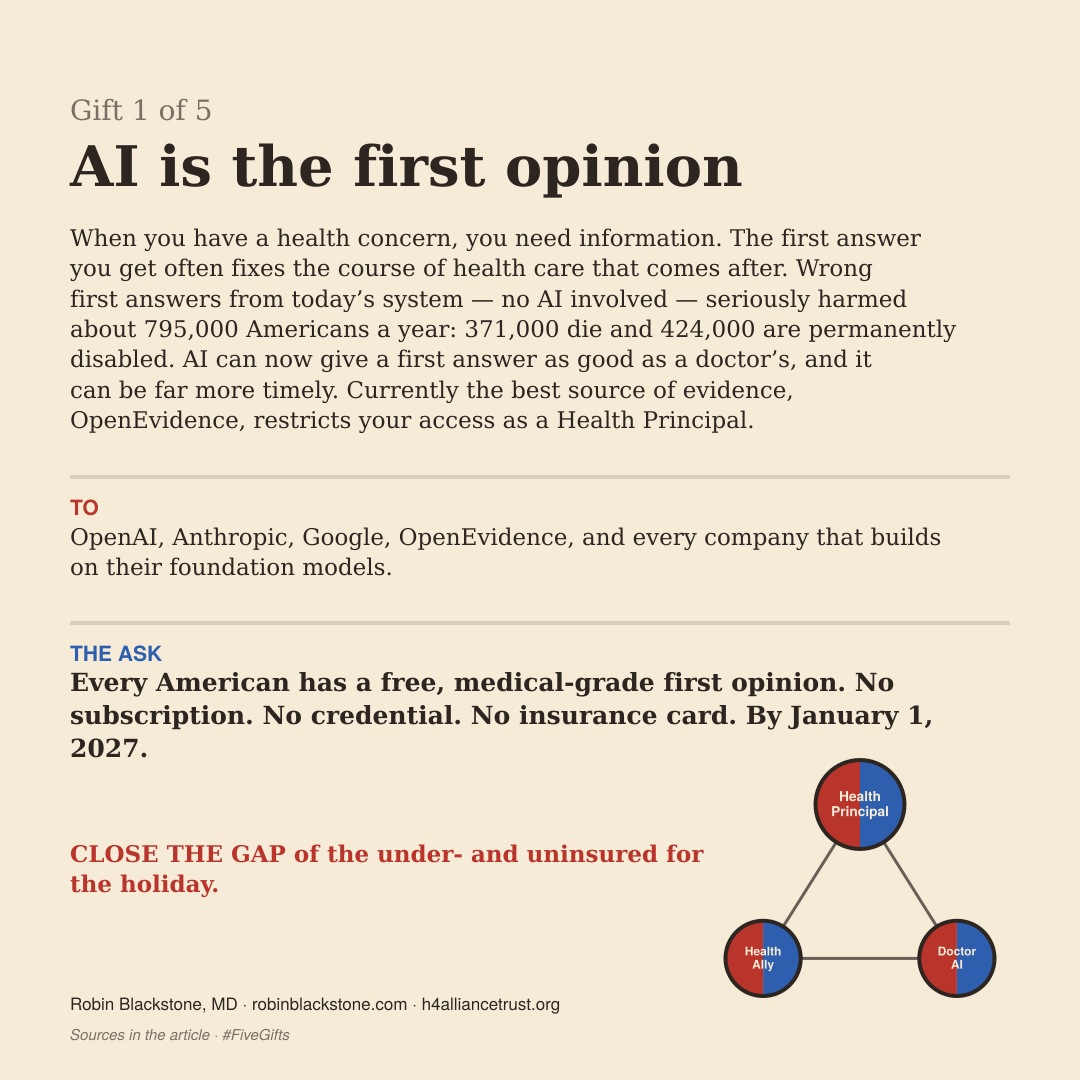
1. AI is the first opinion
When you have a health concern, you need information. The first answer you get often fixes the course of health care that comes after. In 2023 researchers at Johns Hopkins published the first national estimate of how many Americans wrong first answers from today’s system, no AI involved, seriously harmed each year: about 795,000 people, 371,000 dead and 424,000 permanently disabled. Across the fifteen most dangerous diseases they studied, the miss rate was 11%.
AI can now give a first answer as good as a doctor’s, and it can be far more timely and specific to the person: two in the morning, on a phone, for the cost of a text. Currently the best source of evidence in American medicine, OpenEvidence, answers tens of millions of questions a month for doctors; its App Store listing says who may open it: “Healthcare Professionals (NPI Required).” You, the human principal with agency and the person the question is about, cannot use it. However, the literature it reads from was paid for, in large part, by you, through the tax dollars that fund the National Institutes of Health, the largest public funder of medical research in the world.
Having an AI that can offer the first medical opinion closes the gap for anyone without insurance immediately. What about the underinsured? The Commonwealth Fund reported last month that half of working-age adults did not get care they needed in the past year because of cost. By its count, 46% of adults between 19 and 64 are inadequately insured. Their premiums are not low, and they are climbing. Their out-of-pocket costs are rising.
A first opinion with no price on it is the only gift that reaches all Americans.
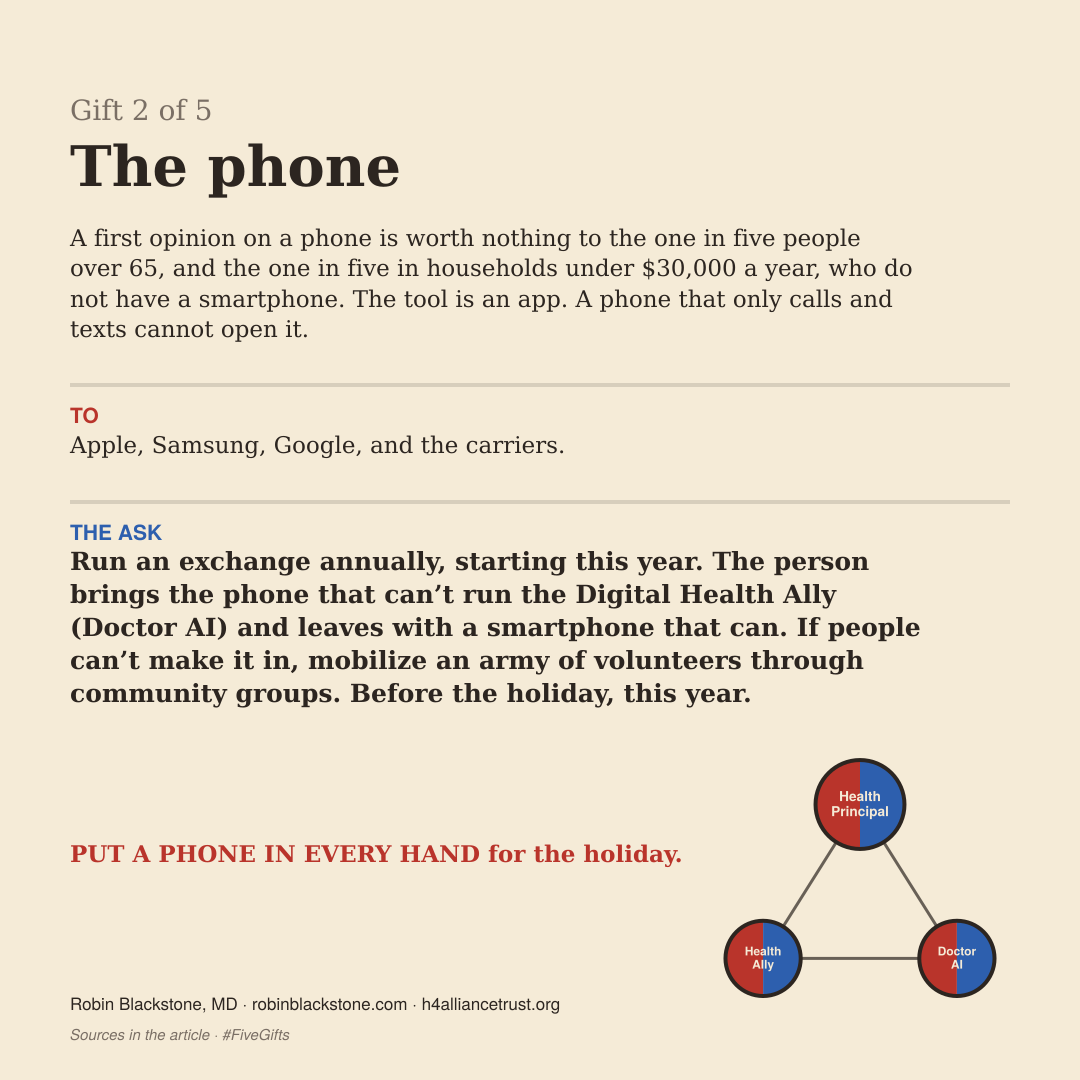
2. The phone
A first opinion on a phone is worth nothing to Americans who do not have a smartphone. That is one in five people over 65, and one in five in households under $30,000 a year. They need a smartphone for a host of reasons, but in terms of health, their digital ally, Doctor AI, is an app. A phone that only calls and texts cannot even open it. Fortunately 91% of Americans own a smartphone, so the gap is small: about 24 million American adults. Apple ships more iPhones than that in a quarter. The replacements could be the refurbished, older models, as long as they are smart enough. If they qualify, the government helps with service: the federal Lifeline program pays $9.25 a month toward it.
Close the gap to health for Americans by the holiday.
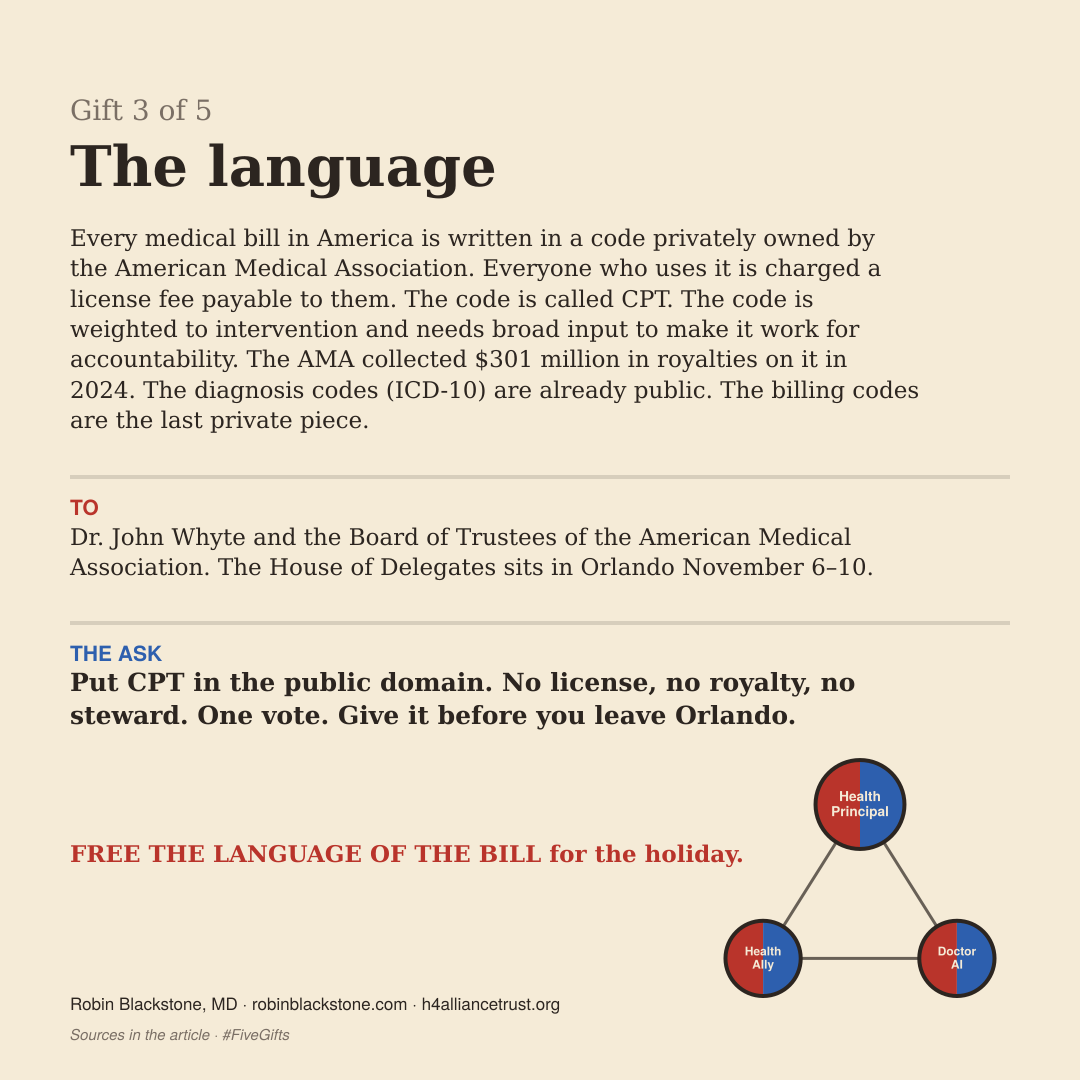
3. The language
Every medical bill in America is written in a code privately owned by the American Medical Association. Everyone who uses it is charged a license fee payable to the AMA. The code is called CPT. Federal rule names it as the required code set for physician services. In 2024 the AMA collected $301 million in royalties on it.
The code itself is overseen by a panel of 21 people; twelve are appointed by the medical specialty societies, meaning it is weighted to intervention. The code would benefit from broader input, to make it a system that works for specificity and accountability. The diagnosis codes, ICD-10, are already public, maintained by the CDC and CMS. The billing codes are the last private piece.
The AMA knows this ask is coming. In July the federal government, in its proposed physician payment rule for 2027, asked the public to describe “the harms or challenges” of the AMA’s control of CPT, and wrote of “longstanding concern expressed over the Federal reliance on a private organization with such an obvious conflict of interest.” In August a patient-rights group sued for the right to publish the codes free. The AMA can spend the next five years as the defendant, or it can give it away first and be the organization that did.
This is the one gift that costs nothing to give and reaches everyone at once: every hospital, every clinic that bills, every person who gets a bill, and every state Medicaid program, all fifty of which run their fee schedules on CPT under the AMA’s license. Nobody has to be retrained, legislated, or reorganized. Dr. Whyte spent seven years at WebMD explaining medicine to the public. Dr. Ajayi, the chair, is a palliative care physician; nobody understands better what the bill means to the family that gets it.
The House of Delegates sits down in Orlando tomorrow, November 6, through the 10th. Put it on the agenda, and give the gift of ownership to the American people.
The best American answer to the question of who owns medical knowledge is still Jonas Salk’s. Asked on live television in 1955 who held the patent on the polio vaccine, he said: the people. There is no patent. Could you patent the sun? The research had been paid for in dimes, mailed in by millions of families. It was already theirs.
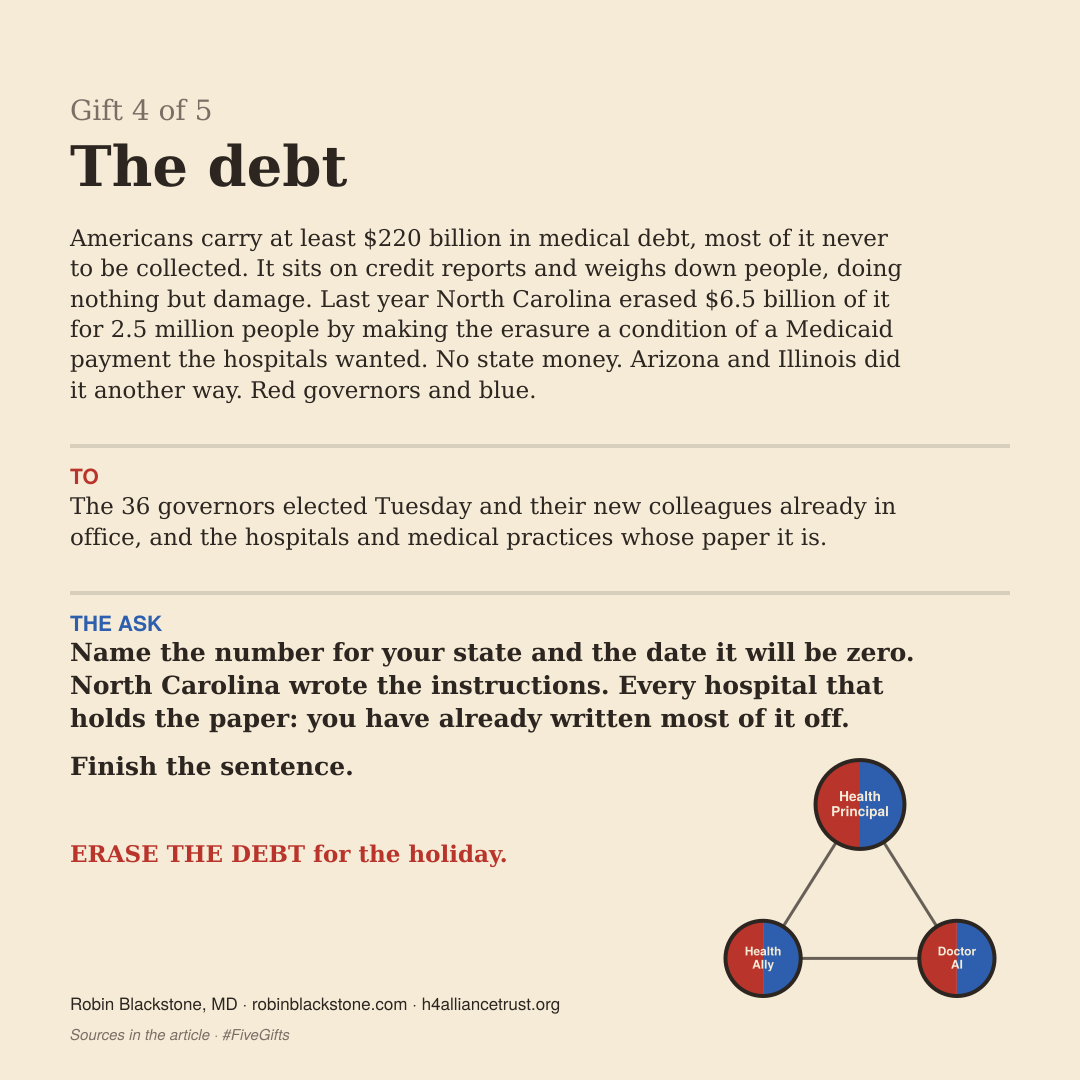
4. The debt
Americans owe at least $220 billion in medical debt, by the best federal survey count. Fourteen million people owe more than a thousand dollars; three million owe more than ten thousand. Most of it will never be collected. It sits on the books, on credit reports, and weighs down people, doing nothing but damage. A bill that will never be paid is not an asset. It is a weight you are choosing to leave on someone.
Last fall, letters went out across North Carolina telling people that hospital bills they had carried for years were gone. Nobody had applied. Nobody had to. The hospitals had agreed to erase the debt because the state had made erasing it the price of a Medicaid payment the hospitals wanted. Ninety-nine hospitals, every eligible one in the state, signed on. More than $6.5 billion erased for more than 2.5 million people, and the state says it spent no state money to do it. Arizona did it another way: more than $1 billion for 670,963 people, through a nonprofit that buys the debt for pennies. Illinois, $1.4 billion for nearly 700,000. Red governors and blue. Nobody waited for Washington.
Relief is a gift the public already paid for, once in taxes and once at the register.
5. The numbers
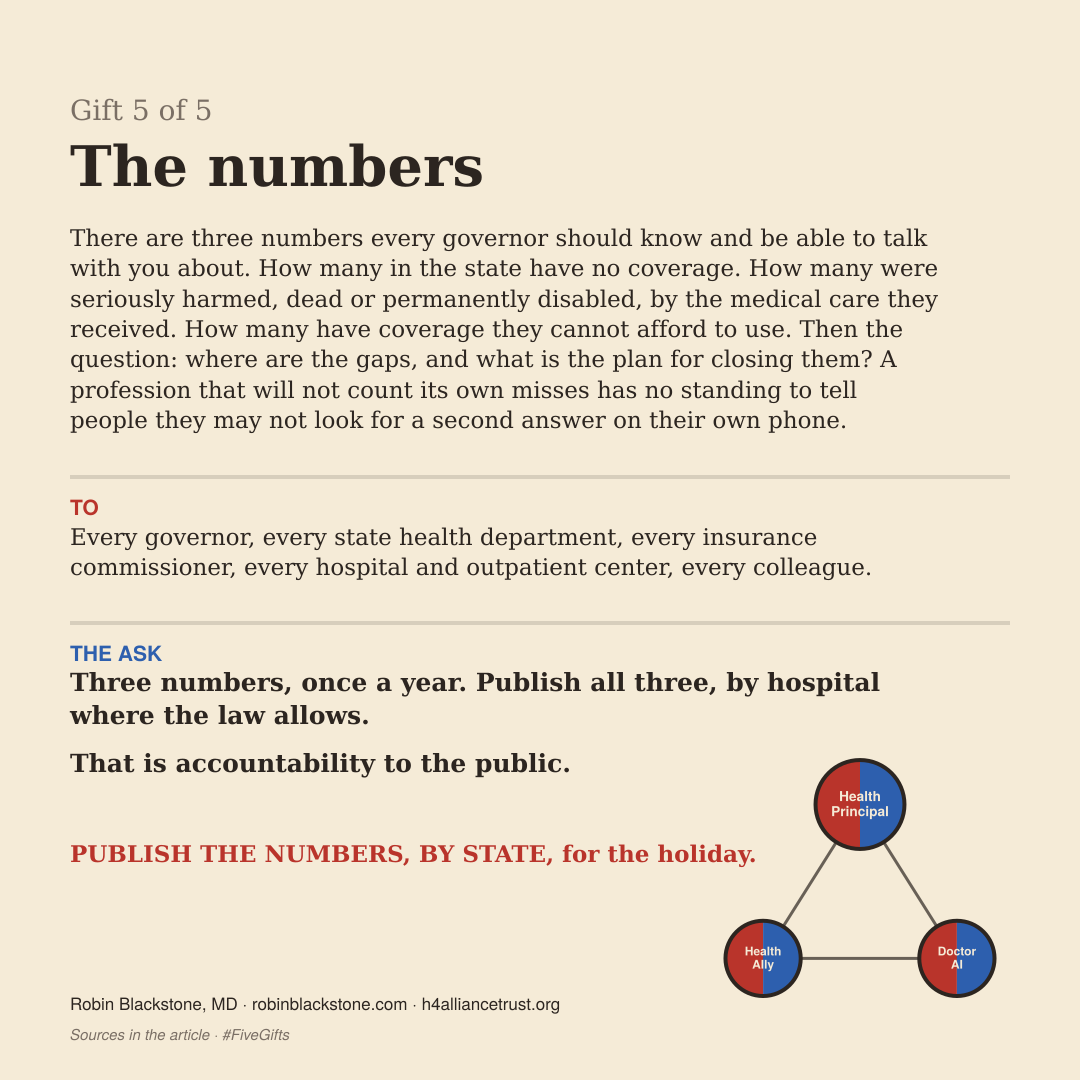
There are three numbers every governor should know and be able to talk with you about. First, how many people in the state have no coverage. The Census publishes it for every state each September. Second, how many people in the state were seriously harmed, dead or permanently disabled, by the medical care they received. The method has existed since 2023; no state publishes it and no hospital is required to. Third, how many have coverage they cannot afford to use. The Commonwealth Fund counts them nationally; no state counts its own.
Then the question. Where are the gaps, and what is the plan for closing them?
A profession that will not count its own misses has no standing to tell people they may not look for a second answer on their own phone. If the answer is an adjective, you have your answer.
Five gifts for 2026. They will keep giving for many years, in good will, in respect, and in fact. Make 2026 the year the American public finally realized health.
The Five Gifts, card by card
Save them. Send them. Post them with the name of the person who can give the gift.
How to tell them
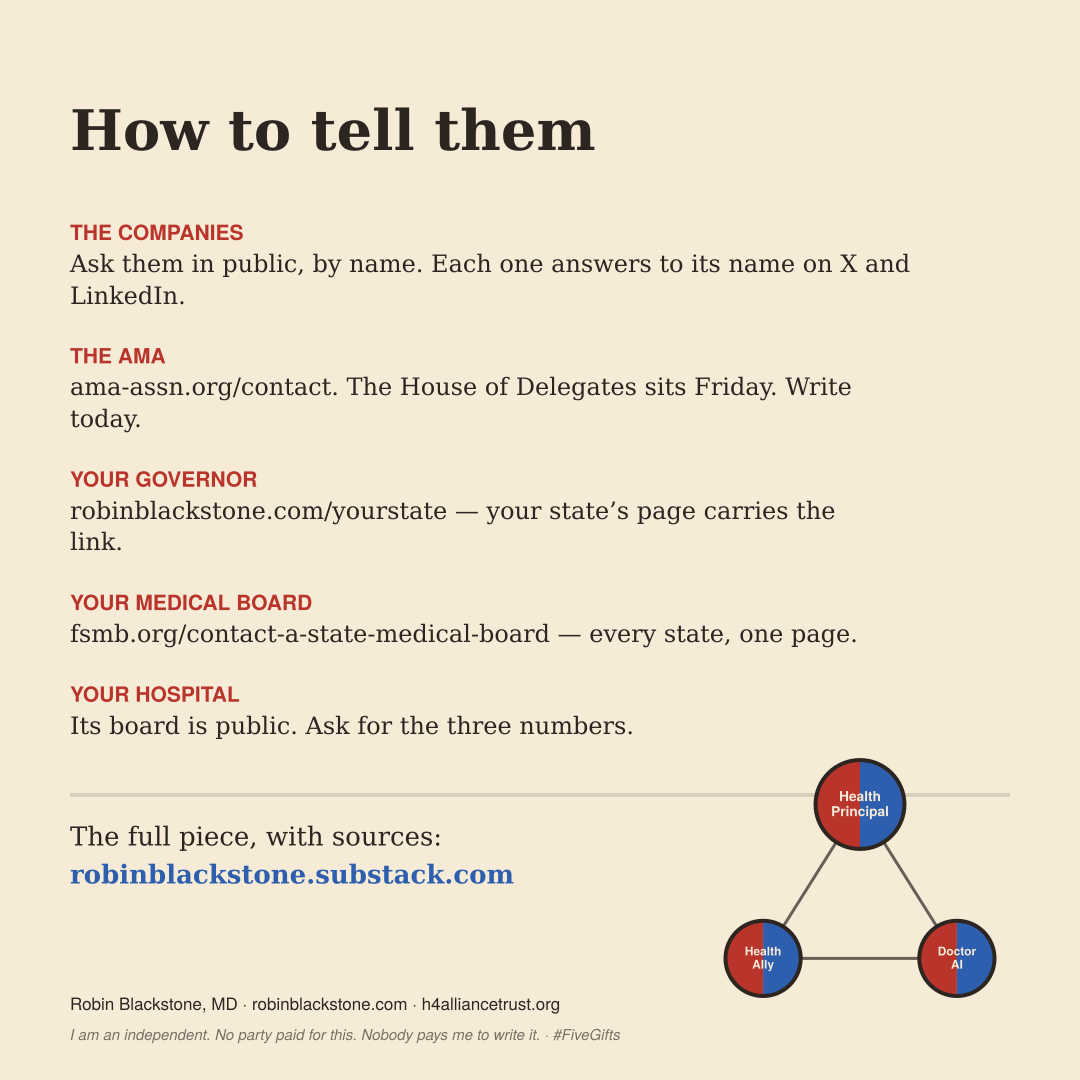
- The companies. Ask them in public, by name. OpenAI, Anthropic, Google, OpenEvidence, Apple, Samsung, and your carrier each answer to their name on X and LinkedIn. A question with your name on it is harder to ignore than a petition.
- The AMA. Its public contact form and phone are at ama-assn.org/contact. The House of Delegates meets in Orlando November 6–10. Write before then.
- Your governor. Your state’s page at robinblackstone.com/yourstate carries the link to the governor’s office and to your representatives in Congress.
- Your medical board. Every state’s board, with its website, complaint form, and phone, is listed on one page at fsmb.org/contact-a-state-medical-board. Ask who sits on it and whether they have decided what you are allowed to ask.
- Your hospital. Its board is public. Ask for the three numbers, and for the date the debt will be zero.
Robin Blackstone, MD, is a surgeon, the founder of Blackstone Health and the H4 Alliance, and the author of Doctor AI and American Health: Who Gets Paid.
Where I stand. I am not a member of any party. No party paid for this. Nobody pays me to write it. I have conflicts of interest like everyone in this field: I founded the companies and the charity that carry this work, including Doctor AI and the H4 Alliance Trust, which raises money for that work, and I write books about it. None of them profit from what you ask for.
The whole campaign: robinblackstone.com/voteyourhealth. If this is useful, forward it to one person.
Sources
The White House, Office of the Press Secretary, “Statement by the President regarding the United States’ decision to stop degrading the accuracy of the Global Positioning System,” May 1, 2000; Selective Availability was switched off at midnight, May 2, 2000. gps.gov: civilian accuracy improved from roughly 100 meters to roughly 10 meters.
KFF Tracking Poll on Health Information and Trust, fielded Feb. 24–Mar. 2, 2026 (n=1,343), released Mar. 25, 2026: 32% of U.S. adults used an AI chatbot for health information in the past year.
21st Century Cures Act, §3060 (2016), 21 U.S.C. §360j(o)(1)(E); FDA, Clinical Decision Support Software: Guidance for Industry and FDA Staff.
Commonwealth Fund, 2026 Biennial Health Insurance Survey (Collins SR, Cil G, Richards C), Oct. 22, 2026; SSRS, fielded May 7–July 20, 2026, 9,360 adults 19+ (7,362 aged 19–64): 11.2% uninsured, 12% with a coverage gap, 23% underinsured (46% inadequately insured); 50% did not get needed care because of cost; 3 in 10 paying off medical debt.
Edward R. Murrow, See It Now, CBS, April 12, 1955: Salk, asked who owns the patent: “Well, the people, I would say. There is no patent. Could you patent the sun?” The National Foundation for Infantile Paralysis (March of Dimes) funded the vaccine’s development and field trial.
Office of Governor Josh Stein and NCDHHS, press release, Oct. 13, 2025: more than $6.5 billion in medical debt erased for more than 2.5 million North Carolinians; 99 acute care hospitals; relief required as a condition of enhanced Medicaid payments under the Healthcare Access and Stabilization Program; no state funds.
Office of Governor Katie Hobbs, press release, Aug. 5, 2026: more than $1 billion in medical debt erased for 670,963 Arizonans, in partnership with Undue Medical Debt; no state funds.
Office of Governor JB Pritzker, press release, 2026: $1.4 billion in medical debt erased for nearly 700,000 Illinoisans, with Undue Medical Debt.
KFF, The Burden of Medical Debt in the United States, Feb. 12, 2024, from the Census Bureau’s 2021 Survey of Income and Program Participation: at least $220 billion owed; about 14 million people owe more than $1,000; about 3 million owe more than $10,000.
U.S. Census Bureau, American Community Survey 1-year estimates: state-level uninsured rates published each September. U.S. Census Bureau, Health Insurance Coverage in the United States: 2025 (P60-291), Sept. 15, 2026: 26.7 million uninsured (7.9%).
Newman-Toker DE, Nassery N, Schaffer AC, et al. Burden of serious harms from diagnostic error in the USA. BMJ Quality & Safety 2024;33:109–120 (online July 2023): 795,000 serious harms/year; 371,000 deaths; 424,000 permanent disabilities; 11.1% mean error rate across 15 dangerous diseases.
Congressional Budget Office, estimates of coverage effects of P.L. 119-21 (publication 61367, Aug. 2025); CBO letter to Wyden, Pallone, Neal, June 4, 2025.
Pew Research Center, Mobile Fact Sheet, survey Jan. 30–June 18, 2026: 98% cellphone; 91% smartphone; 79% ages 65+; 80% household income under $30,000. Applied to the Census Bureau’s estimate of about 265 million adults, 9% without a smartphone is about 24 million.
Omdia, smartphone shipments, Q2 2026: Apple shipped 55.1 million iPhones in the quarter.
45 CFR §162.1002(a)(5): CPT-4 “as maintained and distributed by the American Medical Association” as the HIPAA standard code set for physician services.
American Medical Association, “The purpose of the CPT coding system and the CPT Editorial Panel”: 21 members, 12 appointed by national medical specialty societies, 3 by insurers, 1 by the American Hospital Association, the rest by the AMA.
American Medical Association, IRS Form 990, FY2024 (via ProPublica Nonprofit Explorer): total revenue $546,239,123; royalties $301,440,074.
AMA, “Internal End User License Agreement Royalty Rates for 2026 and 2027”: CPT Standard 2026, “$82.50 plus $18.50 for each User”; Health Plan Model, $0.240 per member (core).
CMS, CY 2027 Physician Fee Schedule proposed rule (CMS-1848-P, released July 14, 2026; FR Doc. 2026-14327), section II.H, request for information on CPT licensing.
American Medical Association, House of Delegates 2026 Interim Meeting, November 6–10, 2026, Orlando.
National Governors Association, Elections: 36 states held gubernatorial elections on November 3, 2026.