Origin Story
 Inspiration
Perhaps it is age that pulls at the edges of my mind, drawing images of my life into view.
When I was turning five, our family moved to the Grand Canyon National Park. We lived on the Loop, in a three-bedroom ranch-style house—standard government issue, nothing fancy, but home to most of my childhood memories. I can still see the best forts I built with my friends; the one you entered by climbing the pine tree and coming through a trap door, the one built of stone with spaces to shoot arrows through.
Next to the house, a tall ponderosa pine provided shade where my lemonade stand appeared on hot days. It was on that worn strip of asphalt in front of the house that my father taught me to ride a bicycle—a bicycle, then as now, a symbol of freedom and independence. Over the years I rode that loop so often I could almost close my eyes and make it all the way around. Riding was both sport and escape. It also gave me my first business, delivering The Williams News for ten cents a copy all over the village. My sister a constant companion in every scheme. We were quite entrepreneurial.
Some Saturday afternoons, though, my father would take me away from the chaos of three kids in a small house. We’d bring a thermos of coffee, some water, a few simple sandwiches, and fruit—simple provisions, easy to carry.
Driving along the Mogollon Rim in our white truck, Casper, we followed the curve of the canyon until we passed beyond the borders of the park. Then we’d turn down a dirt road, rough and rutted, and follow it deep into the ponderosa pine forest. It was always the same road.
As the sound of the truck’s engine faded, the silence began —It wasn’t emptiness. It didn’t make me feel lonely or sad, but it had presence, a feeling of gravity seeping out of the ground. Just a few steps from the truck, and we were deep in it.
The trees rose like sentinels, tall and unwavering, their needles clustered at the upper third of each trunk. Pinecones, which always fascinated me, lay at their feet. The forest floor was blanketed in soft, thick needles. The wind moved only at the upper canopy, whispering down with secrets I couldn’t yet understand.
Below, stillness.
It felt, even then, like a cathedral. The rest of my life—whether in the Vatican in Rome or St. Patrick’s in New York—I have never felt the presence of grace more than in that forest.
These woods were beautiful. You could understand why the Anasazi had once settled here. But it was also remarkable for what you did not hear:
No sound of water.
No babbling brook.
No creeks.
Just silence, stone, and sky.
We walked for hours beneath that canopy of whispers—far from the babble of civilization—and in that silence we found something close to peace.
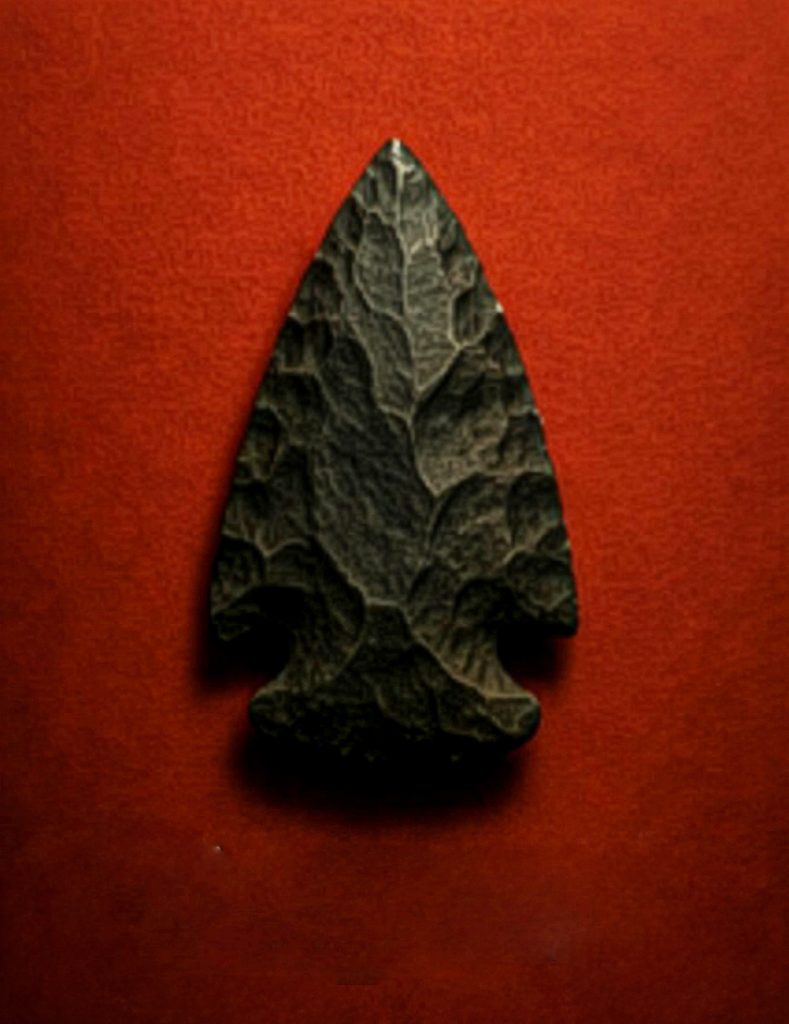
As we walked, our eyes scanned the ground. We were looking for arrowheads, especially the ones that were intact. How many times would I find a rock, show it with great excitement to my father, and he would shake his head explaining patiently why it was, in fact only a rock.
Arrowheads were hard to discern in the mosaic of the forest. When you saw one, it was fleeting—a brief glint of sunlight on flint, half-buried in soil and old pine needles. Sometimes we came upon a simple stone circle, the remains of a dwelling. And there, inside it, a crafted point—sharp, elegant, enduring. I would run my small fingers along the edges, feeling the blows that had shaped it.
I didn’t fully understand the arrowhead’s purpose. Not yet. I knew they were used to kill, to eat, to survive, but I was too young to grasp the tension between necessity and violence, death and life. In that long-ago forest there was no water, no sign of farming or crops—only what you could find and kill to eat. I didn’t yet know that survival could be so precise, existential. Or what that would require. That understanding came later. As a surgeon, I would understand it too well.
Some arrowheads we kept; others we left. But it was never about collecting. It was about the journey—the act of noticing, of seeing the small clues. It taught me the recognition of simplicity hiding in complexity. My questions an exploration of mystery. Why had they left them?
Like so much about the Anasazi, the mystery remains unanswered.
The arrowheads became echoes of a civilization—and in time, echoes of myself. They gave me a language for the future.
Human history is born of such echoes.
They rise and fall through time, etched into landscapes and memory, passed down—or vanish.
These echoes have always spoken to me. They still do.